Share



On the afternoon of 5 August 1949, fifteen smokejumpers parachuted into Mann Gulch, Montana, to fight what looked like a routine forest fire. Within two hours, thirteen of them were dead. The fire jumped the gulch and turned on them. Their foreman, Wagner Dodge, lit a fire at his own feet, lay down in the ashes, and let the blaze pass over him. He shouted at his crew to join him. Not one did. They ran uphill, carrying their heavy tools, and the fire caught them.
It was an organisational psychologist, not an ecologist, who turned this disaster into a landmark. Karl Weick, at the University of Michigan, reanalysed the Mann Gulch fire in a 1993 paper for Administrative Science Quarterly that became one of the most cited articles in organisation studies. His question was deceptively simple: why did trained professionals lose the ability to act sensibly in a crisis they were equipped to handle?
His answer was sensemaking: the ongoing process by which people construct meaning from ambiguous or overwhelming situations. Weick had been building toward the idea since his 1969 book The Social Psychology of Organizing, which reframed organisations as verbs rather than nouns. In 1995, he published the full theory in Sensemaking in Organizations, laying out a concept that would shape decades of research across management, healthcare, military operations, and disaster response.
What sensemaking actually is
Weick defined it with unusual precision: “the ongoing retrospective development of plausible images that rationalize what people are doing.” Every word carries weight.
Retrospective: people understand what they are doing only after they have done it. Action comes first; explanation follows. We do not think our way into acting. We act our way into thinking.
Plausible rather than accurate: sensemaking does not aim at truth. It aims at a story good enough to keep going. In a burning forest, you do not need the perfect map. You need one that gets you moving in roughly the right direction.
Ongoing: sensemaking is not a discrete event triggered by crisis. It runs continuously, beneath every working day. People are always constructing and revising the story of what is happening around them.
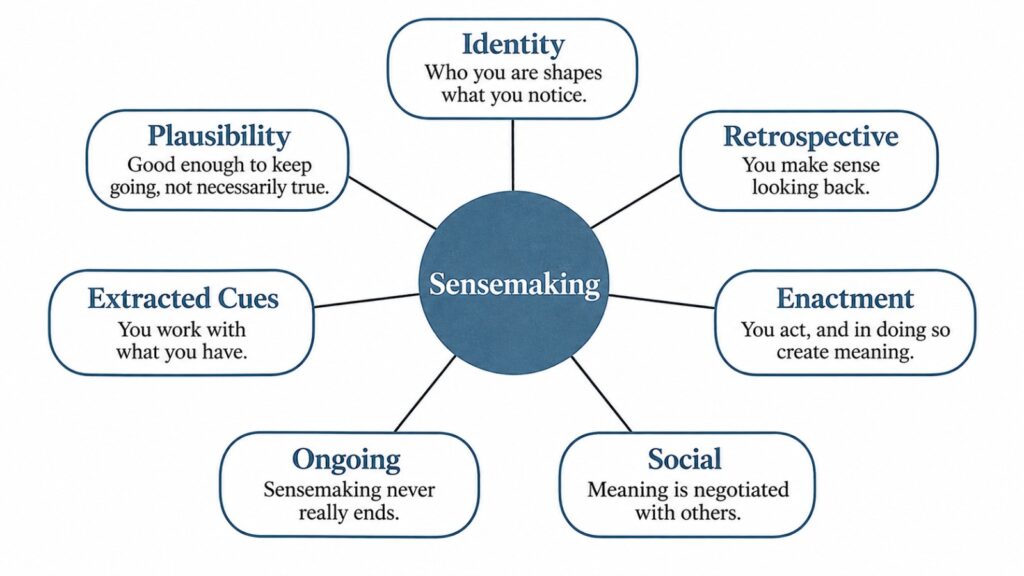
Weick’s seven properties of sensemaking: the filters through which people construct meaning from ambiguity.
Weick identified seven properties that govern the process: it is grounded in identity (who you believe you are shapes what you notice); retrospective; enactive (people create the environments they then respond to); social; ongoing; focused on extracted cues (small signals selected from a flood of information); and driven by plausibility rather than accuracy.
How it breaks
The Mann Gulch paper was about how sensemaking collapses. Weick introduced the term cosmology episode: a moment when the universe simply stops making sense, when the feeling of orderly conduct dissolves. At Mann Gulch, the collapse followed a precise sequence. The fire reversed direction. The foreman lit a baffling counter-fire. The crew lost their shared frame of reference. Their role system disintegrated. (The dynamics of groupthink run close to this territory, though Weick goes deeper into identity than Janis.) They could no longer tell what kind of situation they were in, and so could no longer tell what kind of people they needed to be.
The crew’s refusal to drop their tools became Weick’s most haunting image. Under extreme stress, the smokejumpers clung more tightly to the instruments of their professional identity. The tools were heavy enough to slow them fatally. There is a loss aversion at work here that goes beyond economics: the tools were the last tangible proof that these men were still firefighters, still inhabited a world that made sense. Dropping the tools meant letting go of who they were.
What happened to the theory
Sensemaking became one of the most productive concepts in organisation studies. Weick, with Kathleen Sutcliffe, extended the work into High Reliability Organisations (nuclear plants, aircraft carriers, emergency departments), asking what makes some organisations sustain coherent sensemaking under danger and ambiguity. Their concept of collective mindfulness described organisations that resist simplification, stay sensitive to operations, defer to expertise rather than authority, and treat near-misses as data rather than reassurance.
The theory drew constructive criticism. Sandberg and Tsoukas, in a wide-ranging 2015 review, found that sensemaking scholarship had focused almost exclusively on dramatic disruptions at the expense of the quieter, everyday sensemaking that sustains (or quietly degrades) organisational life. The role of power (who gets to define the plausible story, who gets silenced) had been largely neglected, a gap Maitlis and Christianson and others worked to close. And the framework’s emphasis on retrospection left prospective sensemaking (making sense of what has not yet happened) comparatively thin.
These are real limitations. They mark the difference between a framework that explains everything and one that explains something important very well. Weick’s contribution was always the latter.
The pattern since
The mechanism Weick described at Mann Gulch (identity under threat, cues that stop making sense, a team that cannot construct a shared story fast enough to act) has repeated with grim regularity.
In Australian cricket, the 2018 ball-tampering scandal in Cape Town was a cosmology episode in miniature. A team whose identity was inseparable from aggressive, win-at-all-costs play found itself in a deteriorating series, escalating provocations, and a culture the subsequent Longstaff review described as arrogant and unchecked. Senior players hatched a plan to use sandpaper on the ball. The cues were all there (television cameras, the spirit-of-cricket code, public expectation) and every one was filtered out by an identity that had narrowed to a single imperative: win. The fallout (bans, sackings, a full cultural review) was the organisation trying, belatedly, to rebuild a shared story it could live with.
In India, the 2018 collapse of Infrastructure Leasing and Financial Services (IL&FS) showed what happens when sensemaking fails through structural complexity rather than crisis speed. IL&FS had grown into a labyrinth of over 300 subsidiaries and special-purpose vehicles. Its risk management committee did not meet at all in three of the four years before the default. The board, the regulators, the credit-rating agencies: none could construct a coherent picture of what was actually happening. When the defaults began, the contagion spread precisely because no one had a plausible story to contain it.
Globally, Boeing’s 737 MAX disasters of 2018 and 2019 showed sensemaking collapsing across an entire organisation over years rather than minutes. Engineers raised concerns about the MCAS stall-prevention system; those cues were filtered through a corporate identity that had shifted from engineering excellence to cost efficiency. The incentive structures rewarded exactly the wrong signals. The plausible story that leadership maintained (that the redesign was a routine update requiring minimal new pilot training) held until 346 people were dead.
What it means to lead with
Weick, who died in May 2026 at eighty-nine, left behind a body of work that asks one question with uncomfortable persistence: do you actually know what is happening in your organisation right now, or have you settled for a story that feels plausible enough to stop looking?
The practical test is simple. It is whether you can name the last time you updated your understanding of a situation rather than defending it. Whether the people around you feel able to say “this doesn’t make sense” before things go wrong. Whether you have confused the story you tell about your organisation with what is actually going on inside it.
Sensemaking does not break in one dramatic moment. It degrades quietly, one filtered cue at a time, until the gap between the story and the situation is too wide to cross.
This is the twentieth in a series on research that changed how we understand organisations and the people in them. Each instalment takes one paper or body of work apart: what it found, how the finding has aged, and what a working leader might carry out of it. The work draws from management, organisational behaviour, sociology, and psychology. The selection criterion is simple: it has to have been right about something important, and mostly ignored in the places that needed it. The previous post on engagement is here.
#sensemaking, #KarlWeick, #organisationalbehaviour, #MannGulch, #cosmologyepisode, #highreliabilityorganisations, #organisationaltheory, #crisismanagement, #Boeing737MAX, #CricketAustralia, #IL&FS