Share


The employee engagement software market crossed USD 1.2 billion in 2025. It is projected to reach USD 4.5 billion by 2034. The product is almost always a survey. Employees are asked how they feel. Scores are handed to managers. Managers are told to improve them.
Gallup’s 2025 global data tells us how that is going. Engagement fell to 21 per cent worldwide, its lowest point since 2020. Manager engagement dropped from 30 to 27 per cent. The estimated cost in lost productivity: USD 8.8 trillion a year, roughly nine per cent of global GDP.
A USD 1.2 billion measurement industry presiding over a global decline. The surveys keep shipping. The engagement keeps falling. Something in the model is wrong, and two researchers identified what it was decades ago.
The construct: what engagement actually is
In 1990, William Kahn, an organisational psychologist at Boston University, published a study in the Academy of Management Journal based on fieldwork at a summer camp and an architecture firm. He watched people move in and out of their roles hour by hour and identified three psychological conditions that explained the difference.
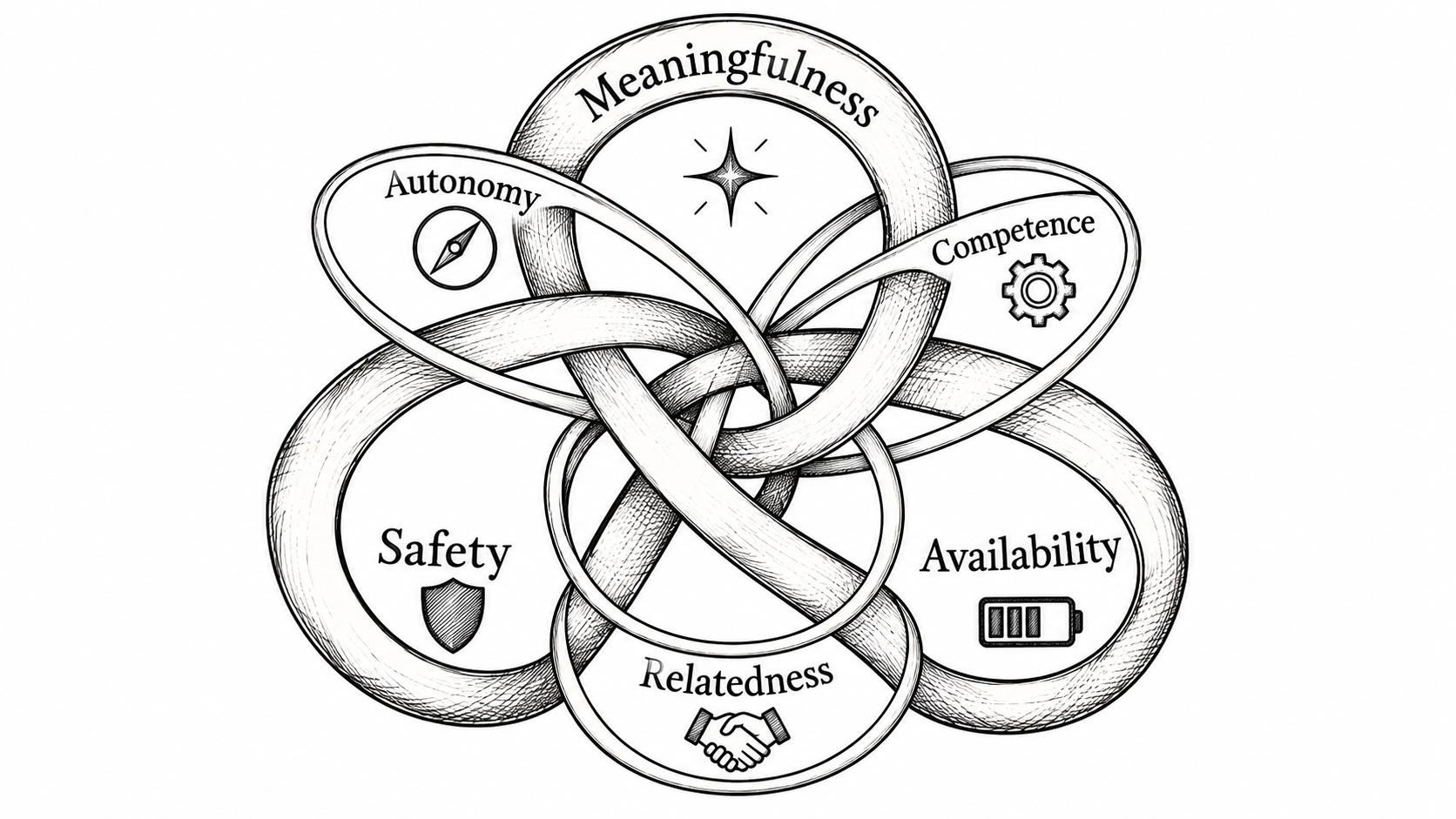
Meaningfulness: the feeling that the work returned something worth the investment of energy. Safety: the sense that one could show up honestly without fear of punishment. Availability: having enough physical, emotional and cognitive resource to actually be present.
Engagement, in Kahn’s account, was not a trait the employee carried in. It was a state the work produced. It shifted within a single day, sometimes within a single meeting. May, Gilson and Harter (2004) later tested these conditions quantitatively at a US insurance company. All three predicted engagement. Meaningfulness was the strongest driver.
The mechanism: why conditions produce motivation
Five years before Kahn’s paper, Edward Deci and Richard Ryan at the University of Rochester published Intrinsic Motivation and Self-Determination in Human Behavior, laying out self-determination theory. Three innate psychological needs drive human motivation: autonomy (volition over one’s actions), competence (feeling effective), and relatedness (connection to others).
When these needs are satisfied, people are intrinsically motivated. When they are thwarted, motivation becomes controlled, dependent on external pressure, and performance narrows to whatever the incentive rewards.
Their 2017 review in the Annual Review of Organizational Psychology confirmed the pattern across decades of workplace research: autonomy-supportive environments produced higher-quality performance and greater wellbeing. Controlling environments produced compliance at best.
Where the two frameworks meet
The overlap is hard to miss once you see it.
Kahn’s meaningfulness maps onto competence and autonomy. Work feels meaningful when you have skill and choice. Kahn’s safety maps onto relatedness. You show up fully when the people around you make that feel safe. Kahn’s availability stands slightly apart. It concerns capacity rather than motivation: you cannot engage when you are depleted, however well the other conditions are met.
Together, both frameworks say the same thing from different directions. Engagement is not a sentiment to be captured in a score. It is a response to conditions. Change the conditions and the engagement follows. Measure the sentiment without changing the conditions and you get data about a problem you are not solving.
What it looks like when someone tries
Atlassian, the Australian software company, built its Team Anywhere distributed work model on precisely the conditions the research describes. Employees choose where and how they work on any given day. Intentional gatherings replaced mandatory presence. The design targeted autonomy and relatedness directly: choice over the shape of the day, structured connection when it mattered.
After 1,000 days, 92 per cent of employees said the policy allowed them to do their best work. Ninety-one per cent said it was an important reason they stayed.
Then, in March 2026, the company cut 1,600 jobs, 10 per cent of its workforce, to fund an AI pivot. The engagement conditions the policy had carefully built were not enough to survive a strategic restructure. A company can design well for engagement and still make decisions that shatter it. The conditions are not a permanent achievement. They require ongoing commitment, and they do not survive on autopilot.
So what do you actually measure?
The research does not say stop measuring. It says measure the conditions, not the mood.
Shorten the cycle. Kahn showed engagement shifts within a day. A yearly survey cannot see that. Monthly pulse checks that ask about conditions — do you have what you need to do your work? can you raise a concern without it costing you? — get closer to the rhythm the research describes.
Read what your systems already hold. Voluntary turnover in the first twelve months tells you about safety: people who leave early never felt they could show up honestly. Internal transfers and stretch-role uptake tell you about meaningfulness: people move toward work that uses them fully. Decisions made without escalation tell you about autonomy. None of these require a survey. All of them are trailing indicators of the conditions Kahn and Deci and Ryan described.
Ask the question no platform can answer. When did someone on your team last disagree with you openly, and what happened next? That tells you more about safety than any engagement score ever will.
Stop measuring what the research warns against. Tying engagement scores to manager performance reviews creates exactly the extrinsic pressure Deci and Ryan spent their careers documenting. The measurement becomes the incentive. The incentive corrupts the measurement.
This is the 19th in a series on research that has shaped how we understand organisations and the people inside them. Each instalment takes one study or body of work and asks what a working leader might actually do with it. The work comes from management, organisational behaviour, sociology and psychology. The selection criterion is simple: it has to have been right about something important, and mostly ignored in the places that needed it. The immediate previous post on first impressions is here.