Share


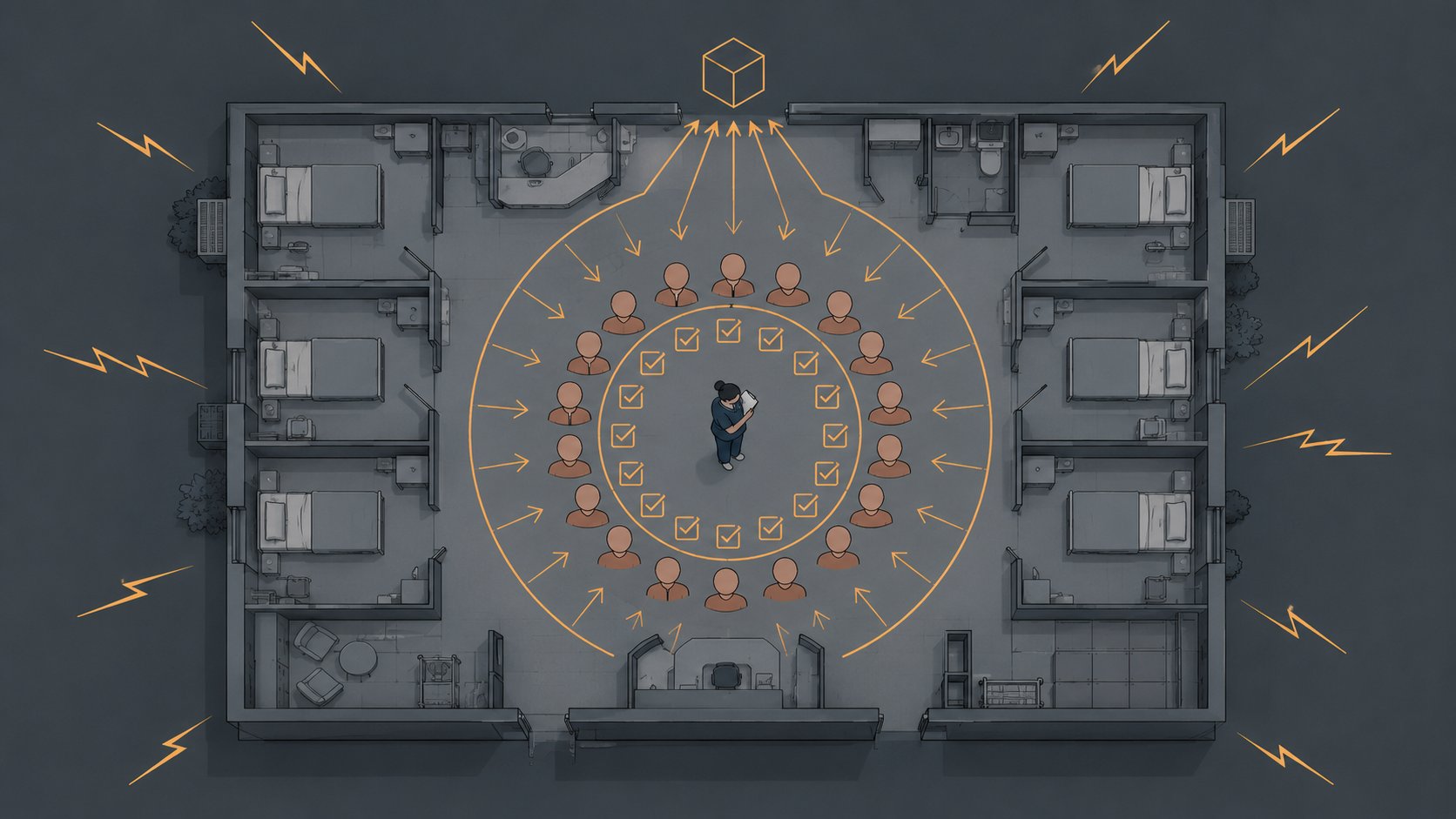
A hospital is struggling to keep its nursing students. The training is rigorous, the work is meaningful, and yet a steady stream of nurses leave partway through the programme. The hospital assumes it is a staffing and curriculum problem, and brings in outside researchers to fix the rota. What they actually find is a textbook case of organisational anxiety, hiding in plain sight inside the rota itself.
The researchers find something else. The nurses are taught to work from a rigid task list rather than use their own judgement. Patients are referred to by bed number rather than name. Responsibility for any decision is passed upward through layers of seniority, so no single nurse ever fully owns an outcome. Students are rotated between wards every few weeks, often before they have had time to grow close to a single patient.
None of this was designed on purpose. All of it was solving a problem nobody had named out loud.
In 1960, Isabel Menzies, a researcher at the Tavistock Institute in London, published a paper in Human Relationsdescribing exactly this hospital. She argued that the practices she found were not inefficiencies to be fixed, but defences: unconscious structures that protected nurses from a form of organisational anxiety so acute it resembled an infant’s earliest fears of helplessness and loss. The paper has gone on to become one of the founding texts of what is now called systems psychodynamics, the study of how organisations behave the way people under stress behave.
What the research actually found
Menzies was not looking for this. She had been called in to solve a structural problem: too many qualified nurses, not enough patients to give students adequate hands on training. What she found instead was a workforce carrying a level of organisational anxiety nobody in the building had a name for, for reasons that had little to do with rotas.
Nursing, she observed, involves a level of emotional exposure most jobs do not. Constant closeness to suffering and death. Decisions that can cost a life. Patients and families who are grateful one moment and resentful the next, dependent on the nurse and humiliated by that dependence. Drawing on the psychoanalytic work of Melanie Klein and Wilfred Bion, Menzies argued this produced anxiety of a primitive, almost pre verbal kind, and that no institution can function if its people are required to feel that, unfiltered, every day.
So the hospital, without anyone deciding to, had built a system to absorb it. The task list let nurses follow instructions instead of being present with a patient’s suffering. Calling a patient “the appendectomy in Bed 7” created distance from a person whose death would otherwise be a real loss. Pushing decisions upward meant no individual nurse carried the full weight of a bad outcome alone. Constant rotation prevented attachments from forming in the first place, so there was less to grieve when a patient died or a placement ended.
Each of these practices solved an emotional problem. None of them solved the actual one. Student nurses left in large numbers not because the work was too hard, but because the system had quietly removed the thing that made the work worth doing: real contact with another person. The organisational anxiety the structure was built to absorb simply found a new, more expensive way out, through attrition.
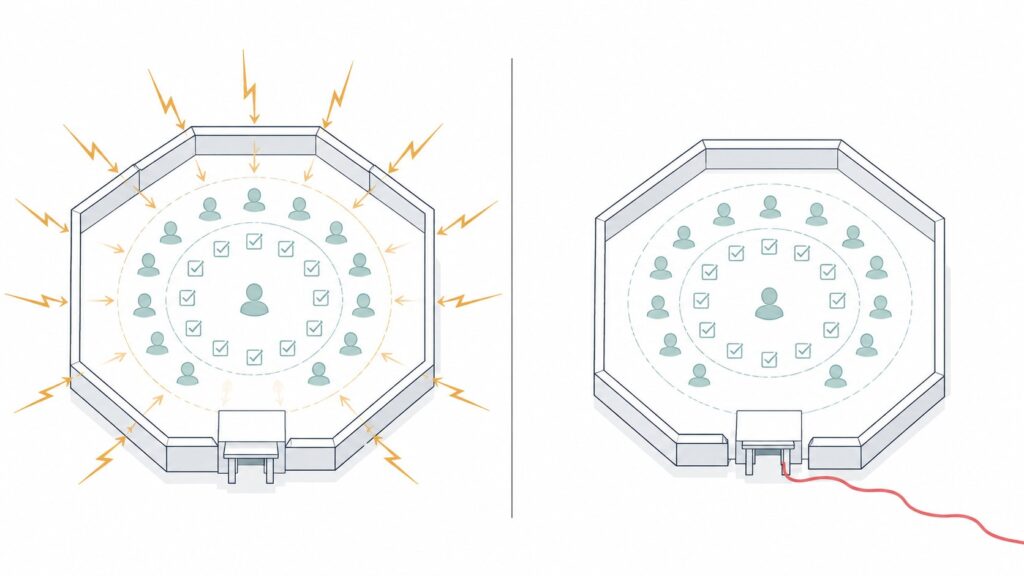
Left: pressure strikes the structure and is absorbed ring by ring. Right: no incoming pressure, but a cost leaks out the door instead. The defence and the symptom are the same system.
What came next
Menzies’ paper sat largely within healthcare and the social professions for decades, used mostly to explain burnout and high attrition among nurses, social workers, and teachers. The bigger claim, that any organisation under sufficient pressure will build unconscious defences into its structure, took longer to be taken seriously outside that world.
In 1998, the organisational researcher Alastair Bain extended Menzies’ framework directly into the question of why companies struggle to learn from their own experience. Bain proposed that organisations develop a “system domain”: a shared, often unspoken structure of defences that multiple parts of the business collude in maintaining, precisely because dismantling it would expose everyone to the organisational anxiety it was built to avoid. His argument was that organisational learning does not fail for lack of data or intelligence. It fails because learning would require people to feel something the system has been carefully built to help them avoid.
This is the bridge between a 1960s hospital ward and a 2026 leadership team. The mechanism does not need patients or scalpels to operate. It needs complexity, stakes, and people who would rather not feel the full weight of either.
What this means if you’re leading
This is, underneath the psychoanalysis, an org design question. Org design is usually framed as a question of efficiency: who reports to whom, how decisions get made, how work flows. Menzies and Bain point to a second, quieter design brief running alongside it: how much organisational anxiety this structure asks people to carry, and where that anxiety goes when it has nowhere left to be felt.
A flatter structure, a faster reorg cycle, a tighter approval chain: each of these is usually justified on efficiency grounds. Each is also, often without anyone intending it, a decision about how much organisational anxiety gets absorbed and how much gets deflected onto someone else, or onto nobody at all.
Where this shows up today
Jeff Bezos described a version of this same mechanism in Amazon’s 2016 shareholder letter, without ever citing Menzies. As companies grow larger and more complex, he wrote, they tend to manage to “proxies” rather than outcomes, and the clearest example is process as proxy. Good process exists to serve the customer. Left unwatched, the process can quietly become the thing itself, and a team can point to it and say it was followed, without ever answering the harder question of whether the work actually mattered.
That is Bezos, in a letter to shareholders, describing the same structure Menzies found on a hospital ward thirty years before he was born. A dashboard of KPIs lets a manager feel the work happened without sitting with whether it mattered. A reorg every eighteen months keeps people from staying anywhere long enough to feel responsible for what they leave behind. None of this is necessarily cynical. It is usually well intentioned people managing organisational anxiety the only way they know how, by building exactly the kind of structure Bain described, one that the whole organisation quietly agrees to maintain.
The corrective Menzies herself pointed to, late in her career, was not therapy or support groups bolted onto a broken structure. It was containment: designing roles, decisions, and continuity so that people can stay close enough to the real difficulty of their work to do it well, without being flattened by it. That is a design problem, not a wellness problem, which is exactly why it sits with the people drawing the org chart, not just the people running the offsite.
So the question worth carrying into your next reorg, your next process redesign, your next round of KPIs: what is the organisational anxiety this structure is actually protecting people from feeling? Sometimes the answer is nothing. It is just good process. And sometimes, if you look closely, the structure is the symptom.
This is the fifth in a series on research that changed how we understand organisations and the people in them. Each post covers one paper or study, clearly described, and what a working leader might do with it. The work comes from management, organisational behaviour, sociology, and psychology. The selection criterion is simple: it has to have been right about something important, and mostly ignored in the places that needed it. Here’s the previous post