Share


On 17 April 1961, fourteen hundred Cuban exiles waded ashore at a beach called the Bay of Pigs, trained and funded by the CIA, briefed to spark an uprising within days. The beach itself was wrong. Coral reefs nobody had checked wrecked the landing craft, air cover had been quietly scaled back in the final planning meetings, and the uprising never came, because the intelligence behind it had been wrong for months, and everyone in the room had let that wrongness stand.
Within seventy-two hours, the operation had collapsed. The room that approved it included the director of the CIA, the Joint Chiefs of Staff, and a president eager to prove his judgement sound. Historians studying the planning sessions found doubts held privately in individual heads around that table, and a meeting whose momentum made objection feel like the riskier move.
The psychologist Irving Janis spent the following decade studying that room. His answer, laid out in Victims of Groupthink (1972), was that cohesive groups under pressure to agree can produce worse decisions than any individual member would reach alone, and they do it while feeling more confident than ever. He called the pattern groupthink, and the mechanism he described has held up across five decades of scrutiny.
The eight symptoms of groupthink
Janis identified eight symptoms. Illusions of invulnerability. Collective rationalisation of warning signs. Belief in the group’s inherent morality. Stereotyping of outsiders as too weak or too evil to negotiate with. Direct pressure on dissenters. Self-censorship, where doubts stay unspoken because the cost of voicing them feels higher than the cost of being wrong. The illusion of unanimity, mistaking silence for agreement. And self-appointed mindguards, people who protect the group from information that might disturb its consensus.
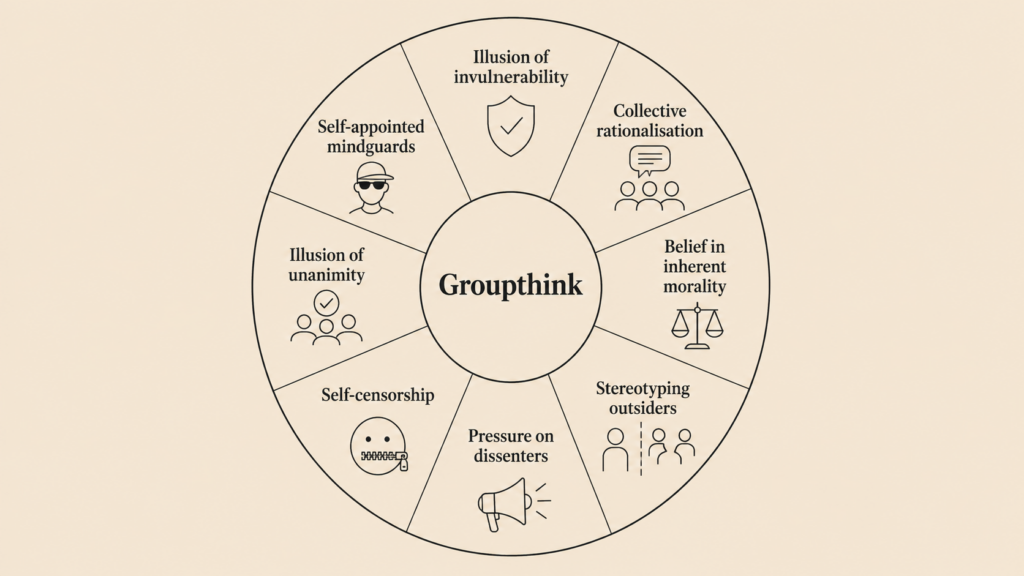
Janis’s eight symptoms of groupthink, and how each one reinforces the others.
The pattern shows up wherever cohesion runs high and dissent runs expensive. Janis traced it through the Bay of Pigs, the escalation in Vietnam, and the failure to anticipate Pearl Harbor. He also studied cases where the same institutions got it right, including the Cuban Missile Crisis, decided by many of the same people who had approved the Bay of Pigs a year earlier, with a deliberately restructured process built to surface dissent. The variable sat in the process itself, and the people around the table stayed largely the same.
NASA engineers gave later researchers a further case. The night before the Challenger launch in 1986, engineers at Morton Thiokol raised concerns about the O-rings in cold weather, and management pressure closed the debate before the concerns were resolved. Twenty-eight years after Janis published his framework, the mechanism he described played out again, in a room full of people who understood the risk and let the meeting’s momentum carry them past it.
What makes groupthink difficult is that it produces good feelings on the way to a bad decision. Members report high satisfaction with group process, and describe the decision as thorough. Dissent, where it exists, stays inside people’s heads, since raising it would mean disrupting a room that has already decided how it feels about itself.
Park’s 1990 review found the empirical picture more conditional than Janis first proposed, with the effect depending heavily on directive leadership and insulation from outside opinion. Esser’s 1998 review, twenty-five years on, reached a similar conclusion. The core phenomenon holds, and the boundary conditions matter more than the original theory allowed for.
How to prevent groupthink
Janis revised his own framework in the second edition of Groupthink (1982), adding structural interventions to the theory. Assign someone the explicit role of critical evaluator, whose job is to find the holes. Split the group into sub-groups that work the problem independently before reconvening. Bring in outside experts who owe the group nothing socially. Have the leader withhold their own preference until everyone else has spoken, since a stated preference from the person in charge closes down the room before the discussion opens. Hold a “second chance” meeting after a decision feels settled, dedicated entirely to residual doubts.
These interventions ask for structure, and structure does the work that courage is usually asked to do instead.
Groupthink in practice: the pattern since
The mechanism has kept recurring, in settings Janis never wrote about. In 2018, Cricket Australia’s leadership group decided, openly and without recorded dissent, to tamper with the ball during a Test match in South Africa. The review that followed described a culture where success had bred a belief that the group’s methods sat beyond question, and where a junior player executed the plan rather than challenge it.
In India, the board of Satyam Computer Services included some of the country’s most credentialed independent directors, and for years they approved accounts built on a fabricated cash balance of roughly ₹5,000 crore. The board’s own reputation for quality became the reason nobody probed harder, and deference to a respected founder did the work that dissent should have done.
Globally, engineers inside Volkswagen understood for years that their diesel engines could not meet emissions standards without a defeat device, and the knowledge travelled sideways through the company without ever travelling up. Regulators in another country uncovered the fraud eventually, well after anyone inside the room where the decision was made might have raised it first.
A working leader can recognise the early signs without a psychology degree. A meeting where the leader speaks first and everyone nods along. A decision where reservations exist and stay in the corridor conversation afterwards instead of the room. A team that describes itself as unusually aligned, unusually good at reading each other, unusually free of the friction other teams complain about. That description sounds like health, and it is often the moment cohesion has started doing the group’s thinking for it.
The fix Janis proposed builds structure into the process itself. A critical evaluator role that exists on the org chart. A leader’s opinion that arrives last. A second meeting scheduled before the first one adjourns. Cohesion is worth protecting, and it stops being an asset the moment it becomes the reason nobody speaks. Groupthink rarely announces itself. It arrives dressed as consensus.
This is the fifth in a series on research that changed how we understand organisations and the people in them. Each post covers one paper or study, clearly described, and what a working leader might do with it. The work comes from management, organisational behaviour, sociology, and psychology. The selection criterion is simple: it has to have been right about something important, and mostly ignored in the places that needed it. Read the previous post on organisational design and anxiety here.