Share


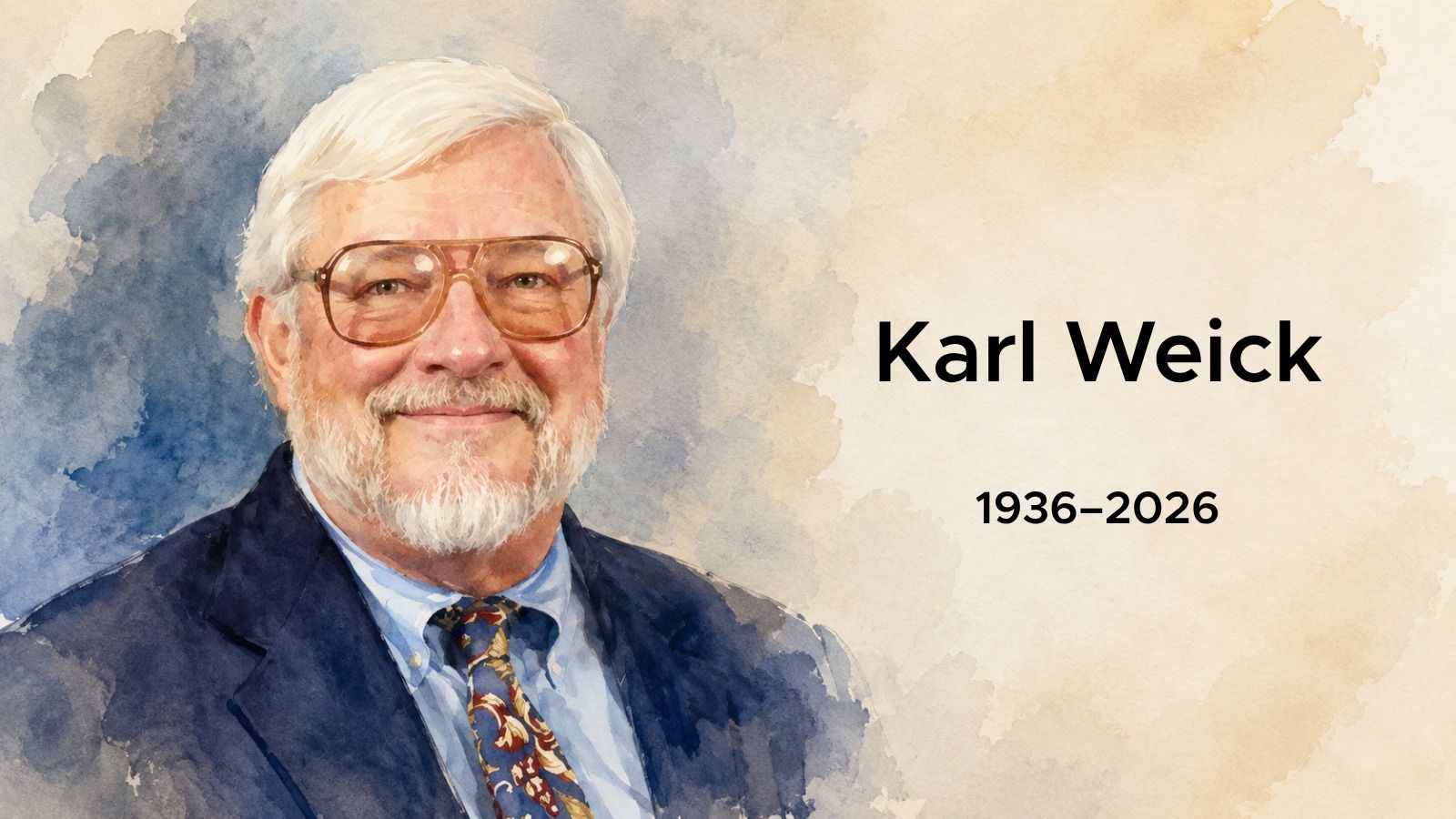
This is a tribute. We do not write many. We are writing this one because Karl Weick’s work sits close to how we think, and has done for years. Karl Weick is a giant in the field. This is our way of saying thank you and celebrating his life.
Karl Weick did not fit in. As a young student at Ohio State, none of the psychology courses suited him. So the university built a new degree, just for him and one other student.
Then he spent the next sixty years building ideas the rest of us still use.
Weick died on 21 May 2026, aged 89. He spent most of his career at the University of Michigan. He is the reason a lot of how we talk about organisations now sounds like plain common sense.
Loose coupling.
Mindful teams.
We use these words without remembering that someone made them up. That someone was Karl Weick.
His main idea is simpler than it sounds. Organisations work out what is going on after they act, not before. People do something, see what happens, and then tell a story that makes the action add up. Understanding comes late. We build it from what already took place. Weick borrowed a line from the writer E.M. Forster to sum it up, and used it so often it became his: “How can I know what I think until I see what I say?”
This cuts against a lot of popular talk. We are told to set an intention, picture the result, and will it into being. Decide what you want, and the world is meant to fall in line. Weick saw the order reversed. We act first, and the meaning catches up. Often the plan is a story we tell afterwards to explain what we already did.
His later work looked at places where mistakes get people killed. Aircraft carriers. Air traffic control. Wildfire crews. The teams that coped well shared a few habits. They watched the small signals. They kept asking what might go wrong. They did not rush to tidy up a confusing picture too soon.
This is the ground our work stands on. Much of what we do at Flyntrok comes back to a simple test. Can a group agree on what is actually happening, well enough to act on it together? When a change effort stalls, or an AI rollout quietly fails, the cause is rarely a lack of brains. People simply cannot agree on what is going on. So they pull in different directions, or they wait. Weick spent a career on that exact problem.
Weick gave that failure a name. He turned it into something a leadership team can see and fix, rather than a vague feeling that things are not landing. That is what good thinking does. It turns a fog into a problem you can hold.
The biggest sign of his success is that his words no longer sound like his. They have become part of the furniture. We make sense of things. Read weak signals. We notice when a team has caused its own trouble. We do all of it in his words, usually without a thought for where they came from.
So this is a tribute, and a plain thank you. Flyntrok pays its respects to Karl Weick, 1936–2026. We have built on his work for years, often without saying so out loud. A giant whose shoulders you forget you are standing on. He is gone. The shoulders hold. You just remember them now.