Share


When pension saving is opt-in, about sixty per cent of workers sign up. When the same scheme is opt-out, over ninety per cent stay in. Nothing changes about the pension. The only difference is which choice feels like a loss.
That pattern traces back to a single experiment published in 1981.
Where it started
Amos Tversky, a psychologist at Stanford, and Daniel Kahneman, at the Hebrew University of Jerusalem, had spent the late 1970s showing that mental shortcuts produce predictable errors. In 1979 they published prospect theory. Its central claim: people judge outcomes as gains or losses from wherever they happen to be standing. And losses hurt roughly twice as much as equivalent gains feel good.
Two years later they designed a test for that idea.
The test
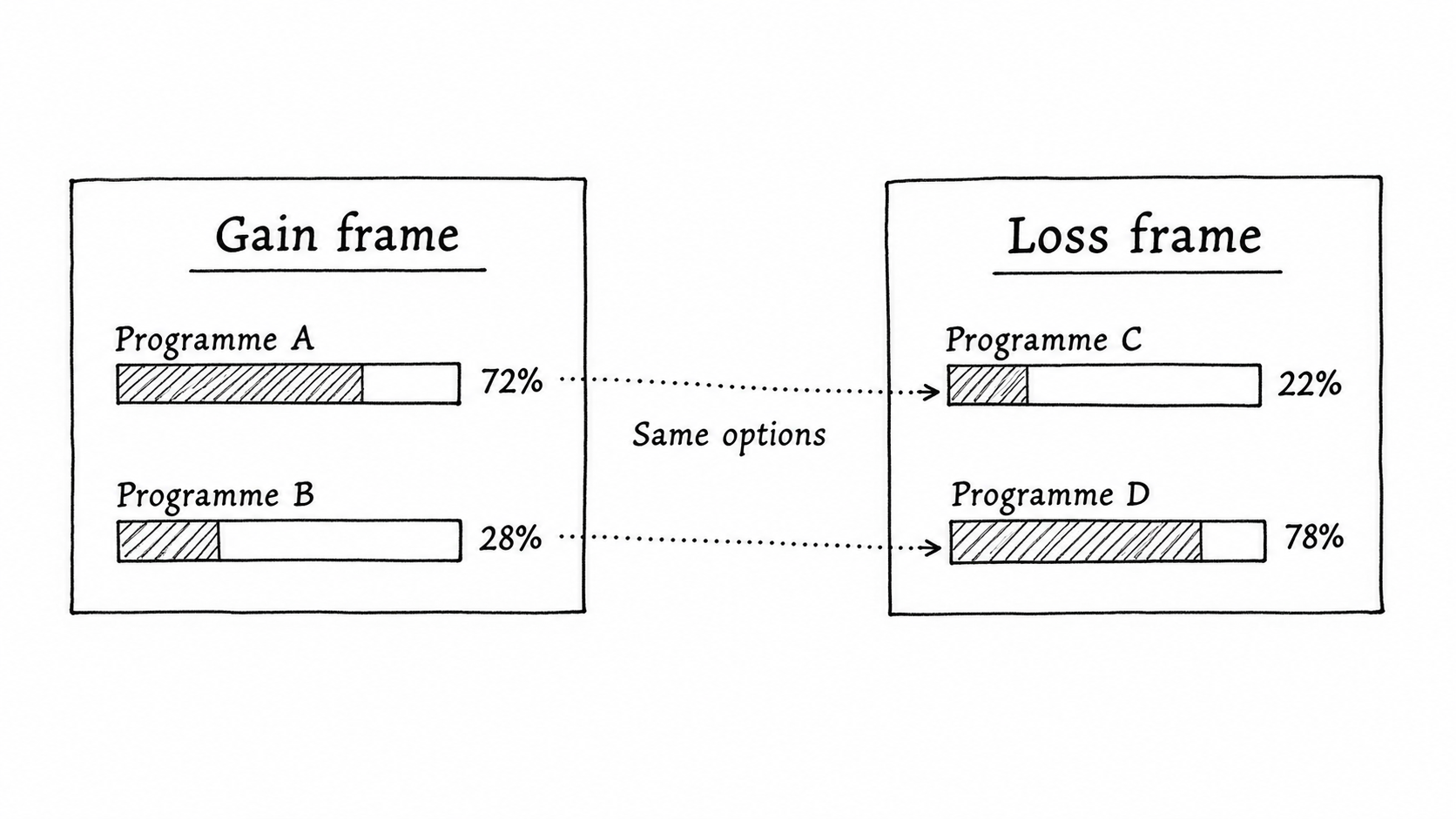
Participants were split into two groups. Group one: a disease will kill 600 people. Programme A saves 200 for certain. Programme B offers a one-in-three chance of saving all 600. Seventy-two per cent chose A.
Group two got the same scenario in different words. Programme C means 400 will definitely die. Programme D offers a one-in-three chance nobody dies. Seventy-eight per cent chose D.
A and C are the same option. So are B and D. All that changed was whether the description pointed at what would be kept or what would be lost. In the gain frame, the certain option felt like locking in a win. In the loss frame, it felt like accepting a guaranteed loss. People fled from it, even into worse odds.
How it held up
Within a year, McNeil, Pauker, Sox and Tversky tested framing on surgeons. Told a procedure had a ninety per cent survival rate, eighty-four per cent recommended it. Told it had a ten per cent mortality rate, fifty per cent did. Medical training offered no shield against the bias.
Levin, Schneider and Gaeth (1998) sorted the literature into three types of framing effect: risky-choice, attribute, and goal. Druckman replicated the original in 2001. Mandel challenged it as a quirk of wording. The Data Colada team reran it and found the effect survived. Four decades on, the core finding holds.
The pattern since
The mechanism shows up wherever someone controls the description. When Telstra announced 2,800 job cuts in 2024, the company led with gain-frame language: simplifying, improving, resetting. Employees heard only loss: thousands of roles gone, families blindsided.
India’s Swachh Bharat Mission worked the other direction, choosing the loss frame deliberately. Rather than promoting the benefits of toilets, the campaign emphasised deaths caused by open defecation. Goal framing at national scale. India’s 2019 Economic Survey credited the approach explicitly.
The largest application sits in defaults. The UK’s pension auto-enrolment took participation from sixty-one to eighty-three per cent in two years. Opt-out organ donation in Spain and Austria sits above ninety-nine per cent. Opt-in Germany: twelve. Opting out means giving something up. Loss aversion does the rest.
What to do with this
Next time you present a decision, rewrite the options the other way round. Then notice which version your audience reaches for. The answer will tell you less about the option than about the clothes you dressed it in.
This is the seventeenth in a series on research that reshaped how we understand organisations and the people who work in them. Each post takes one study and asks what it found, how it held up, and what a working leader might do with it. The selection criterion is simple: it has to have been right about something important, and mostly ignored in the places that needed it. The previous one on cognitive dissonance is here.