Share



Fire some of your smartest people. Replace them with new people who know less. The organisation gets smarter.
That is one of the results James March published in 1991, in Exploration and Exploitation in Organizational Learning. He was serious. His computer model kept producing it.
March was a political scientist. He spent most of his career at Stanford. He also taught a course on leadership built around two novels, Don Quixote and War and Peace. He had already helped write the founding books of modern organisation theory.
By 1991 he was asking a smaller question. Every company has limited time, money and attention. How does it split that between getting better at what it already does, and finding out what it does not yet know?
He gave the two activities names.
Exploitation means improving what you already have. Doing it faster, cheaper, cleaner. Fixing the process. Serving the same customer better.
Exploration means searching for something new. Testing things. Taking risks. Playing around. Most of it fails.
A company needs both. And both want the same money, the same people, and the same weeks.
How he tested it
March did not study real companies here. He built a computer model. That matters, so it is worth saying plainly. A model can show you how something works in theory. It cannot prove it happened in the world. (The full paper is freely available if you want the original model, dials and all.)
Here is the model.
The organisation holds one shared set of beliefs. March called this the code. The code is the company’s official wisdom. It sits in the procedures, the training, the way things are done here.
Inside the company are individual people. Each one has their own beliefs. A few of those people happen to be right about something the code has wrong.
Two things then happen at the same time. People learn from the code. They absorb the company way. March could set the speed of this. The code learns from people. But only from the people who are currently doing well. He could set this speed too. Then he ran it forward and watched.
The result was steady. When both speeds are fast, everyone agrees quickly. They agree on a view that is only half right. Then they stop improving. Nobody is left holding the odd belief that might have been correct.
When both speeds are slow, the company takes longer to agree. People disagree for longer. And in the end, the company knows more.
That explains the strange result at the top. New people have not learned the company way yet. In the short term they are ignorant. In the long term they are the only source of difference.
Why companies drift
The second half of the paper explains why this is so hard to stop.
Rewards from exploitation come soon. They are reliable. It is easy to show that you caused them.
Rewards from exploration come late. They are unpredictable. Very often they are negative.
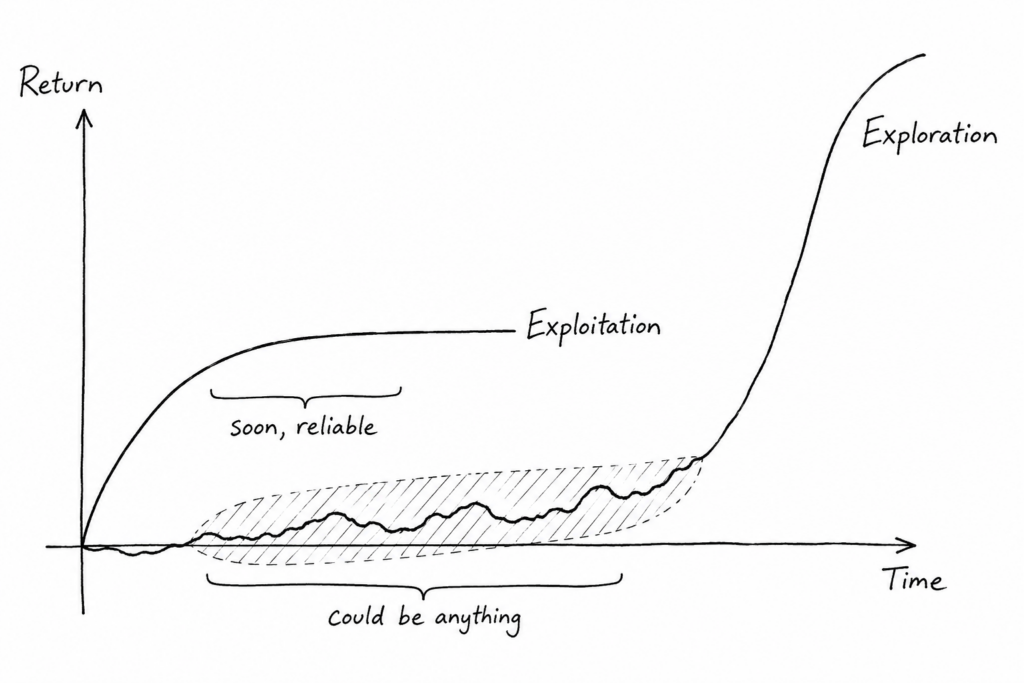
Exploitation pays early and reliably. Exploration pays late, unevenly, and sometimes not at all, which is exactly why organisations quietly favour the first over the second.
So any company that learns from its own experience will find exploitation more rewarding. It will keep finding it more rewarding. That continues until the world changes underneath it.
March called this the myopia of learning, in a follow-up paper with Daniel Levinthal in 1993. Myopia means short-sightedness. You only see what is close.
Companies are short-sighted in three ways. They care too much about the near future. They care too much about what is happening near them. And they pay too much attention to their wins.
That last one sounds odd. Here is what it means. Failures do not stay around. A failed project gets cancelled. A failed manager leaves. A failed company shuts down. After a few years, the failures are gone. Only the wins are still there to study.
So the company is learning from a list that has quietly had the bad news removed.
There is one more turn, and it is the strange part.
Think about a market with many companies and one big winner. In that market, playing safe is a losing plan. The safe plan gives you a decent result almost every year. The risky plan gives you many bad results and a few enormous ones. Only the enormous ones win the market.
The careful company does fine. Every year. And never comes first.
The book he wrote at the end
March came back to this in 2010, in a book called The Ambiguities of Experience. It is the same argument, older and darker.
His question is simple. Do companies actually learn anything reliable from experience?
Mostly no.
Experience comes in small amounts. Too many things happen at once, so you cannot tell which one caused the result. And history only runs once. The version where you chose differently never exists, so you can never compare.
What companies produce instead is stories. A story survives because it sounds right and fits what people already believe. Sounding right is not the same as being right.
March separated two kinds of learning. In the first kind, you copy whatever worked last time, without knowing why it worked. In the second kind, you actually understand the reason. Companies do the first one constantly and call it the second.
He was hardest on business books that study successful companies and list their habits. Every company that did the same things and failed has already dropped out of the sample. So what you are reading is the behaviour of survivors, and nothing more.
That removes most of the airport bookshop. It also removes a few of my own favourites, which I have written about in this series with more enthusiasm than the evidence deserved.
What this looks like in the world
Kodak. Kodak built a working digital camera in 1975. In 1981, its own analysts predicted correctly that digital would kill film, and gave it about ten years. Kodak knew. Kodak also had a film business earning close to 70 per cent margins. Every single quarter, the safe money won the argument.
Bajaj Auto. For decades, India had waiting lists years long for the Chetak scooter. Bajaj became excellent at making scooters. Then the market opened up and Indian buyers switched to motorcycles. The excellence became the trap. Bajaj did not really recover until the Pulsar in 2001, and it eventually stopped making the product that had defined it.
Cochlear. The Sydney hearing-implant company is the counter-example. It has protected a large share of revenue for research across every cycle, including the years when cutting it would have made the results look better. That is separation done through the budget rather than the org chart.
What a leader should do
None of this is fixed by wanting to be more innovative. The drift is caused by ordinary good management. So the fixes have to be ordinary too.
Protect the money before the year starts. Set a fixed share of the budget for exploration and agree it cannot be moved mid-year. If it can be moved, it will be moved, and always in the same direction.
Judge new work by learning, not by revenue. A young project has no numbers. If you ask it for numbers, you will kill it. Ask instead: what did we find out that we did not know three months ago?
Do not let the core review the new work. The people running the profitable business will always have a stronger case, better data and a nearer payoff. Review the two separately.
Protect the new people. For their first year, people who have not yet learned “how we do things here” are your only source of different thinking. Ask them what looks wrong. Do it before they stop noticing.
Keep the failures. Write down the projects you killed and why. Keep the list. It is the only way to stop learning from a sample made only of winners.
Two questions for your next planning meeting.
Which of our current projects would still be funded if the person defending it could not point to a near-term number?
And when we say we learned something last year, can anyone explain why it worked? Or only that it worked?
This is the twelfth in a series on research that changed how we understand organisations and the people in them. One paper at a time, from management, organisational behaviour, sociology and psychology, with a note on what a working leader might actually do with it. The selection criterion is simple: it has to have been right about something important, and mostly ignored in the places that needed it. The previous paper on Institutional Isomorphism is here.
Further reading: Wilden, Hohberger, Devinney and Lavie revisited the paper’s legacy in 2018: Whither Exploration and Exploitation?
Internal link: on how the same drift shows up in how organisations avoid hard feedback — see Double-Loop Learning and Defensive Routines