Share



Between 2018 and 2019, Australia ran a public inquiry into its banking industry. It was called the Royal Commission into banking misconduct. Banks had to send their top executives to answer hard questions in public, on the record, in front of a retired judge named Kenneth Hayne.
At one hearing, Hayne held up a document from one bank. It was called a “risk culture framework.” This is the kind of document a bank writes to explain how it thinks about risk and how it tries to avoid the next scandal. Hayne pointed out that this document read almost word for word like the one from a different bank, sitting at the same hearing, on the same day.
He asked the bank’s chief executive why. The answer was simple. He said it reflected the industry standard.
That is not a dodge. It is close to true, and that is the interesting part. Two American sociologists explained why this happens, in banks and in almost every other kind of organisation, more than forty years before Hayne asked his question.
What is institutional isomorphism
The idea is called institutional isomorphism. The word “isomorphism” just means “the same shape.” So the whole term describes organisations ending up with the same shape as each other.
In plain terms: organisations working in the same field, such as banking, healthcare, or education, tend to become more alike over time. Two banks, or two hospitals, or two universities, can start out with very different histories, leaders, and problems. Over the years they often end up with the same job titles, the same internal policies, and the same language in their annual reports. This happens because looking similar feels safe to the people who judge an organisation from the outside: regulators, investors, clients, and rival companies in the same industry. It happens even when the shared approach does not actually perform any better, because looking similar signals that the organisation belongs and can be trusted.
This is the pattern behind Hayne’s question at the hearing. Two banks did not write similar risk documents by accident. They wrote them because the industry had quietly agreed, without ever holding a meeting about it, on what a “proper” risk document looks like.
Why this matters
Here is the consequence, and it is the part worth sitting with. Looking the same as everyone else is not the same as being fixed.
A bank can produce a risk document that looks exactly like its competitors’ and still carry the same underlying problems, because the document was written to reassure people outside the bank, not to force real change inside it. The paperwork can pass every check while the actual behaviour in the branch, or the trading floor, or the call centre, stays the same.
That is the real cost of institutional isomorphism. An organisation can spend years, and a great deal of money, looking responsible, while doing very little that actually reduces risk, improves a service, or fixes the problem the document was supposed to solve in the first place. The appearance of reform becomes a substitute for reform, and it can take a scandal, or a Royal Commission, to expose the gap.
Where the idea came from
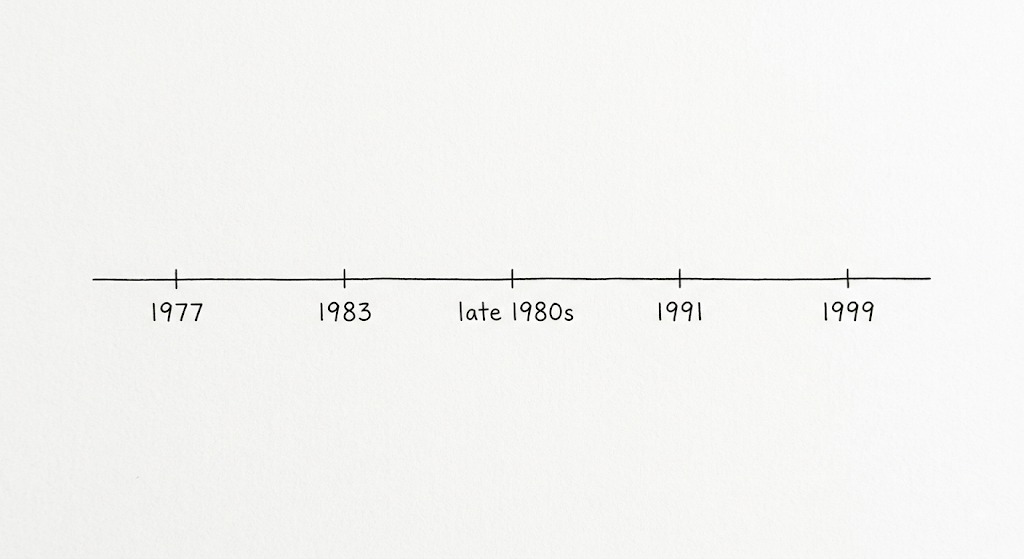
The story starts with John Meyer and Brian Rowan, two sociologists at Stanford. In 1977, they noticed something odd about how organisations build their formal structures. A lot of what an organisation puts on paper, departments, job titles, official policies, is not really there to help the work get done. It is there to look proper to outsiders. They gave a name to the gap described above, between what is written down and what actually happens: “decoupling.”
Six years later, in 1983, two other sociologists took this further. Paul DiMaggio had spent his early career studying arts organisations, like museums and theatres. Walter Powell had studied publishing houses and the networks of people who run them. Together they asked a sharper question. If organisations are chasing the appearance of doing the right thing, rather than actually doing the right thing, what exactly pushes them all toward the same appearance?
Their paper was called “The Iron Cage Revisited.” The answer they gave has lasted.
What kind of evidence this actually is
It is worth being honest here. DiMaggio and Powell did not run an experiment. They did not collect a big dataset and test it. Their paper was a piece of careful thinking, built by pulling together existing research on how groups of organisations in the same industry, along with their regulators and suppliers and professional bodies, come to think alike.
This matters because a good argument is not the same thing as proof. DiMaggio and Powell named a pattern clearly. Other researchers had to go and test whether the pattern was real. Some of that testing is described below, and it holds up well.
Three reasons organisations copy each other
Three roads, one destination.
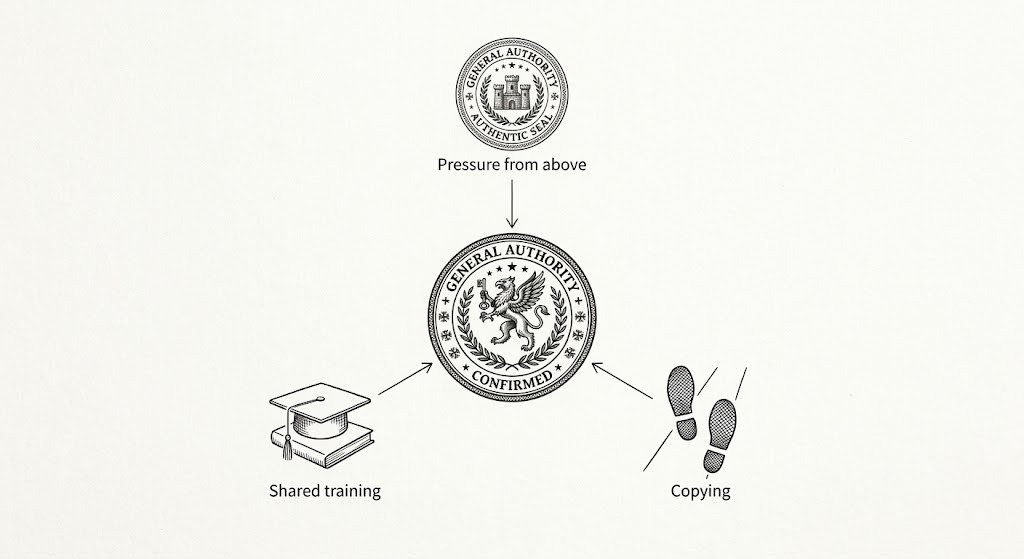
DiMaggio and Powell said there are three separate forces that push organisations to become similar.
The first is pressure from above. A regulator, a government body, or a powerful client can simply force every organisation in a field into the same shape. After the Royal Commission, Australia’s banking regulator, APRA, pushed every major bank toward the same kind of risk and compliance structure. Nobody had a real choice. This is called coercive isomorphism. It is the easiest of the three to explain, and the easiest for a chief executive to admit to, because there is someone else to blame.
The second is copying, because nobody is sure what actually works. Through the 1990s and 2000s, Indian IT companies rushed to get ISO and CMM certificates. These certificates were meant to prove good quality software. In practice, the certificate did not reliably predict better code. What it did was signal, to nervous clients abroad who had no easy way to judge quality themselves, that a company belonged in the conversation. This is called mimetic isomorphism. When nobody is confident about what produces good results, organisations copy whoever looks successful. Copying feels safer than working it out yourself.
The third is quieter, and does not announce itself at all. Managers trained at the same business schools, certified by the same professional bodies, and reading the same trade press tend to arrive at meetings already agreeing with each other, without ever discussing the matter first. This is called normative isomorphism. It is a large part of why practices like Agile working and OKRs have spread into industries that have nothing to do with software. Nobody forced it. People with the same training simply already believed in it.
Did the theory hold up
Forty years of checking one idea.
It has aged well, and this is not just an assumption.
Pamela Tolbert and Lynne Zucker tested the idea in the same decade. They studied how a reform to hire civil servants by merit, rather than by political favour, spread across American city governments. They found a clear pattern. The first cities to adopt the reform did so because it solved a real problem. The later cities adopted it simply because everyone else had. Efficiency drove the early adopters. The need to look proper dragged the rest along.
Christine Oliver added an important correction in 1991. Organisations are not passive. They do not just absorb every pressure put on them. They can resist it, negotiate with it, or quietly ignore it.
Here is the part I enjoy most. Mark Mizruchi and Lisa Fein went back through decades of academic papers in 1999 and counted how often each of the three mechanisms was cited. Mimetic isomorphism, the copying-under-uncertainty story, was cited far more often than the other two, and the reason was not that the evidence favoured it more. It was simply the easiest one to reach for in a conference paper. A theory about organisations copying each other lazily ended up getting copied by the academics who studied it.
Back to the hearing room
Within about eighteen months of the Royal Commission’s findings, nearly every major Australian bank had matching risk frameworks, matching board committees, and matching language about “conduct risk.” The regulator had set the floor. Uncertainty about what real reform even looked like did the rest. Two of the three mechanisms worked together, exactly as the theory predicted, and the documents multiplied faster than anyone could check whether the underlying behaviour had actually changed.
What this looks like at your own company
This arrives in different forms. It arrives as a slide deck from a consulting firm that has already presented the same deck, with a different logo, to your two closest competitors. Someone in the room recognises the framework from a conference last year. “Where the evidence is that it will actually work here?”, is not a questions that is asked. Because most people in the room already half believe in it, having picked up that belief somewhere else long before this meeting was scheduled. By the time anyone might have asked the question, the document has already been approved as the new standard, and the real problem it was meant to solve is still sitting there, now hidden behind paperwork that says it has been dealt with.
This is the eleventh post in a series on research that changed how we understand organisations and the people who work in them. Each post looks at one paper and asks what a working leader can actually do with it. The subjects come from management, organisational behaviour, sociology, and psychology. The selection criterion is simple: it has to have been right about something important, and mostly ignored in the places that needed it. The previous one on expectations driving performance is here.