Share



A senior partner is reviewing a project that has just failed for the third time in a year. Across the desk sits the associate who ran it, sharp, well credentialled, good with clients. Asked what went wrong, the associate has an answer for everything. The client changed scope halfway through. The market shifted. The team was understaffed from the start. Every explanation points outward. None of them touches what he might have done differently.
This is not a story about a bad employee. It is the exact pattern that occupied the organisational psychologist Chris Argyris for most of his working life.
Argyris taught first at Yale and then, for several decades, at Harvard Business School. He trained in psychology and became fascinated by a specific puzzle: organisations hire people for their intelligence, and those same organisations keep repeating the same mistakes. Somewhere between individual competence and collective learning, something was breaking down. He spent the next forty years, much of it in partnership with the philosopher Donald Schön, trying to find out what.
How he studied it
Argyris did not run laboratory experiments or send out surveys. He and his colleagues worked inside real organisations, as consultants, and recorded what actually happened in the room. Executive meetings, coaching sessions, client reviews: taped, transcribed, and analysed line by line.
The method, which he called action science, compared two things. First, what people said they believed about how they operated: their “espoused theory”. Second, what their actual words and choices on the transcript revealed they believed: their “theory-in-use”. The gap between the two turned out to be the whole story.
This approach has a real limitation, worth naming plainly. The organisations Argyris studied were his own clients, people who had sought him out because something was already going wrong. That is not a random sample, and it makes the work hard to generalise in the statistical sense. What kept the findings credible was repetition: the same pattern kept showing up, across industries, across countries, over four decades of engagements.
Single loops and double loops
Argyris’s central idea is easiest to see through a thermostat. A thermostat notices the room has drifted from the target temperature and turns the heating on or off to correct it. It never questions whether the target itself is right. That correction, within an unchanged goal, is what Argyris called single-loop learning.
Double-loop learning goes further. It asks whether the target (the underlying assumption, goal, or “governing variable”) was the right one to begin with. Most organisations, Argyris found, are highly practised at single-loop correction and remarkably poor at double-loop correction. They fix the symptom and leave the assumption that produced it untouched.
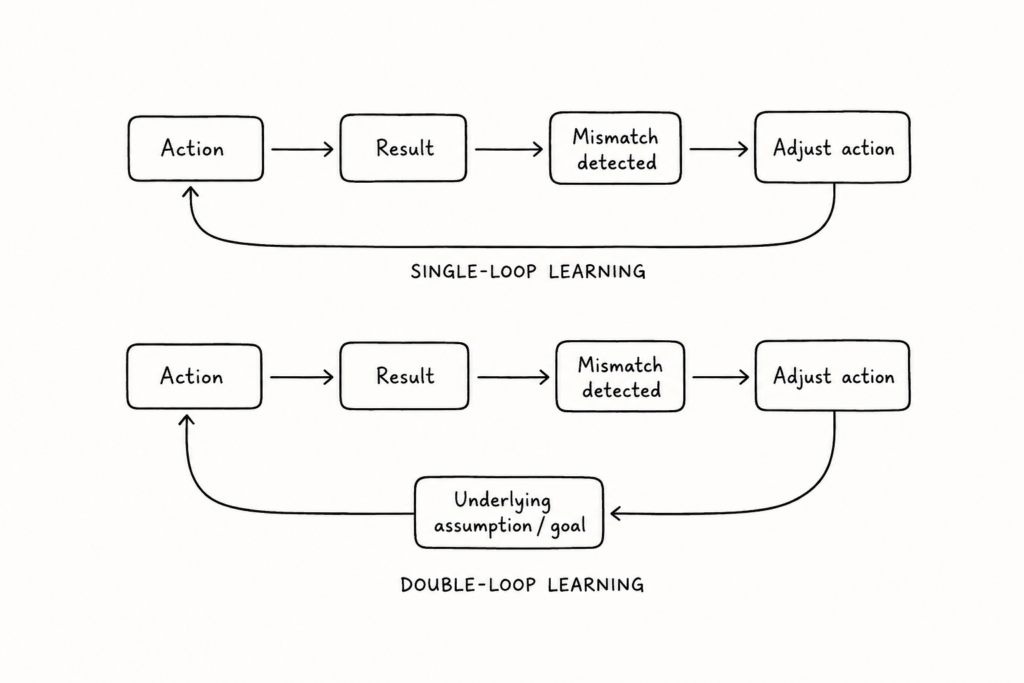
Single-loop vs double-loop learning, Argyris
The reason lies in what he called Model I behaviour: an unconscious set of norms guiding how competent professionals act under pressure. Win, do not lose. Stay rational and suppress negative feelings. Keep control of the situation unilaterally. These norms feel like professionalism. In practice, they produce defensive reasoning: arguments built to protect the person making them, rather than to test whether they are actually right.
At an organisational scale, defensive reasoning hardens into defensive routines: policies and habits that let a whole company avoid facing an uncomfortable truth. A status report that never mentions failure. A meeting where everyone can see the real problem and nobody names it. Argyris gave this a sharp label, skilled incompetence, because the people most prone to it are usually the most successful in the room. Their very success has given them the least practice at tolerating the discomfort of being wrong.
What later research did with it
Peter Senge folded double-loop learning into The Fifth Discipline in 1990, making it one pillar of his popular idea of “the learning organisation”. That gave Argyris’s work a wide audience, and a reputation as strategic wisdom rather than tested science.
The sharper empirical test came from Amy Edmondson, who studied under Argyris at Harvard. In a 1996 study of hospital nursing teams, she measured how many medication errors each team reported. The result was the opposite of what a naive reading would predict: the best-led, most collaborative teams reported more errors, not fewer. Independent observation showed these teams were not making more mistakes. They were simply willing to say so. Edmondson named the condition that made this possible “psychological safety”: a team climate in which admitting a mistake does not threaten your standing.
This gave Argyris’s originally qualitative mechanism a measurable, testable form, decades after the fact. It also travelled well beyond hospitals: Google’s internal 2015 research into what made its own teams effective, known as Project Aristotle, independently rediscovered psychological safety as the single strongest predictor of team performance, connecting a Silicon Valley data exercise back to clinical work Argyris had begun in the 1970s.
Defensive routines in practice
When Satyam Computer Services collapsed in 2009, its founder admitted the company’s profits had been inflated for years. Internal concerns about the accounts had reportedly circulated without ever being escalated into a correction, a boardroom-level defensive routine that let a fiction persist until it became too large to hide.
The sociologist Diane Vaughan’s research into NASA’s Challenger disaster in 1986 found that engineers’ warnings about known flaws had been filtered out through layers of routine reporting that made it organisationally comfortable to keep flying. The same pattern, in a different technical guise, reappeared seventeen years later in the loss of Columbia, proof of how stubbornly a defensive routine survives even after it has already caused a catastrophe.
What a leader can do with this
Asking for “honest feedback” once does not build double-loop learning. It requires removing the norms that reward looking right over being right.
Two things help in practice. When reviewing a failure, separate the person from the problem, and ask what assumption made the action seem reasonable at the time, not just what happened. And model it yourself first: admitting your own mistake in front of the room costs you something real, which is exactly why it is the signal that makes it safe for everyone else to do the same.
This is the sixth in a series on research that changed how we understand organisations and the people in them. Each post covers one paper or study, clearly described, and what a working leader might do with it. The work comes from management, organisational behaviour, sociology, and psychology. The selection criterion is simple: it has to have been right about something important, and mostly ignored in the places that needed it. Previous post in this series is here: Groupthink