Share



A woman sits in a basement room at Stanford in the mid-1970s. She has been afraid of snakes for most of her life. The fear has cost her gardens, holidays, whole categories of ordinary movement. In the room there is a boa constrictor in a glass case, a psychologist, and a sequence of very small steps. First she watches him hold it. Then she touches it with a gloved hand. Then without the glove. By the end of a few sessions she has the snake in her lap.
What interested Albert Bandura was not that the fear went away. It was what else went away with it. The study tested snake phobics through progressively more threatening interactions with a boa constrictor, against a comparison group who only watched a therapist do it. Patients who came in for snakes left with changes in things that had nothing to do with snakes — public speaking, driving, applying for work. Something general had shifted, and it wasn’t their skill with reptiles.
Bandura grew up in Mundare, a hamlet in Alberta with a school that had two teachers for the whole secondary curriculum. He came to psychology half by accident, filling an early-morning slot at the University of British Columbia because he was carpooling with engineers who started before he did. By 1953 he was at Stanford, and by 1961 he was famous for the Bobo doll studies, which showed children copying aggression they had only watched. The through-line of his career was that people learn enormous amounts without being rewarded for anything, simply by observing and by forming beliefs about what they can pull off.
In 1977, in Psychological Review, he named the belief. Self-efficacy is your judgement about whether you can execute a particular action to a particular standard. It is not self-esteem, which is how you feel about yourself in general. It is narrower and more useful than that: a claim about a specific task, in a specific situation.
The distinction that does the work
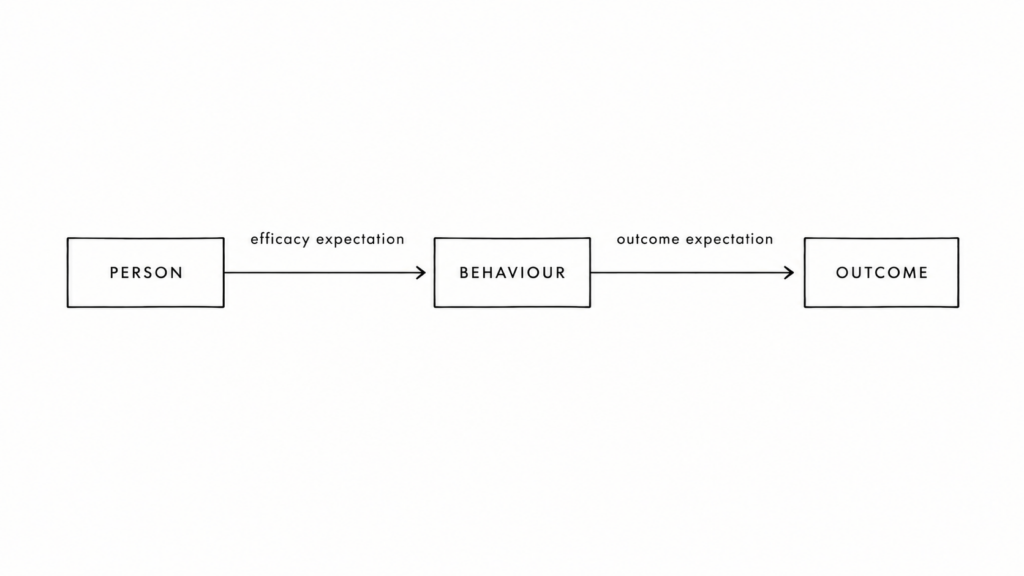
Bandura’s distinction between efficacy and outcome expectations
Bandura separated two expectations that people routinely mash together.
An outcome expectation is the belief that a certain behaviour leads to a certain result. Practising the pitch produces a better pitch.
An efficacy expectation is the belief that you can actually perform that behaviour. You can do the practice, under pressure, when tired, when it goes badly the first time.
People can hold the first and lack the second, and when they do, they don’t start. This is the mechanism, and Bandura stated it plainly in the abstract: expectations of personal efficacy determine whether coping behaviour is started at all, how much effort goes into it, and how long it is sustained in the face of obstacles. Two people of identical ability behave differently because one of them treats a setback as information about the task and the other treats it as information about themselves.
He specified four sources, in descending order of power.
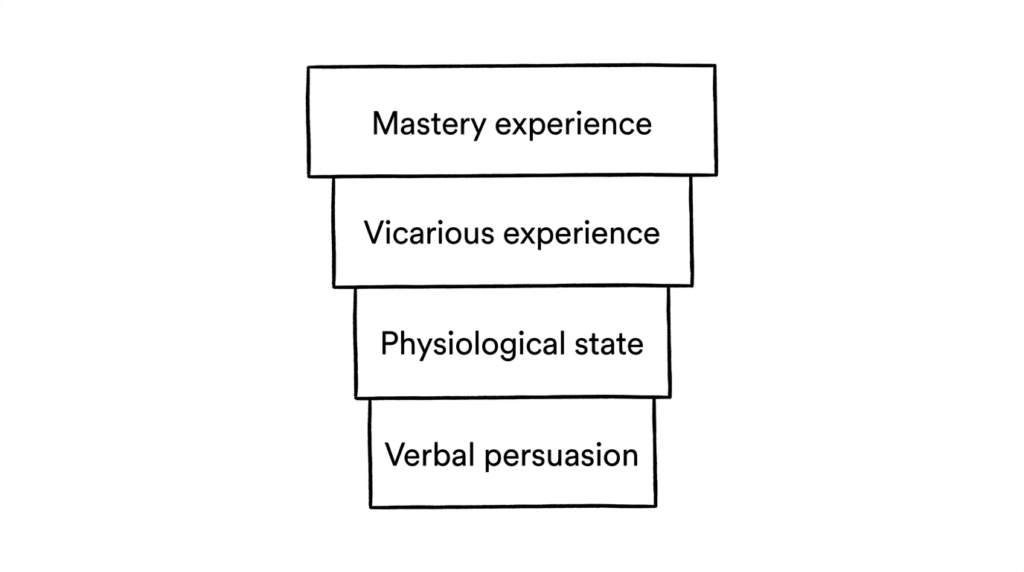
The four sources of self-efficacy ranked by strength
Mastery experience. Doing the thing and succeeding. By far the strongest, and the reason his snake treatment worked through performance rather than talk — performing the task beat watching someone else perform it.
Vicarious experience. Watching someone comparable to you succeed. The comparability matters: a novice watching an expert learns less than a novice watching another novice.
Verbal persuasion. Being told you can. The weakest of the four, and the one organisations overwhelmingly prefer, because it is free.
Physiological and affective states. How you read your own racing heart. Interpreted as readiness, it helps. Interpreted as evidence you’re out of your depth, it doesn’t.
What happened to the idea
It became one of the most cited constructs in psychology, which is a reason for suspicion rather than comfort.
The supportive evidence is real. Alexander Stajkovic and Fred Luthans pooled the workplace studies in 1998 and found a weighted average correlation of .38 between self-efficacy and work-related performance across 114 studies and more than 21,000 people — stronger than most interventions managers reach for.
Then Jeffrey Vancouver found something awkward. Looking within individuals across repeated measures rather than comparing people against each other, high self-efficacy sometimes predicted worse subsequent performance, apparently through under-allocation of effort. Bandura and Edwin Locke pushed back hard in 2003, arguing that the weight of nine meta-analyses contradicted the finding and that the alternative amounted to a recommendation to undermine people’s belief in themselves. Bandura was still making the same argument in 2012. The dispute was never fully settled, which is the honest position to report.
Traci Sitzmann and Gillian Yeo landed a quieter blow in 2013. Their meta-analysis asked, in the title, whether self-efficacy is a product of past performance or a driver of future performance — and within a person, the evidence leaned towards product. The belief may be more scoreboard than engine. Both things can be true: efficacy beliefs sustain persistence across people, and within one person they largely reflect what already happened.
The pattern since
Historical, 1954. Roger Bannister ran 3:59.4 at Iffley Road on 6 May, against advice from physiologists that the attempt was impossible and dangerous. John Landy ran 3:57.9 in Turku forty-six days later, and fifteen more runners followed within three years. A barrier that had held for nine years dissolved in under two months. Vicarious experience, operating on a global scale.
India, 2023. Chandrayaan-3 touched down near the lunar south pole on 23 August, four years after Chandrayaan-2 crashed. ISRO’s response to the failure was not exhortation. The lander got stronger legs, more propellant, improved sensors, rewritten software and a wider landing area, and its legs were tested on lunar simulant beds to survive a vertical touchdown speed of three metres per second. That is the deliberate manufacture of grounds for confidence, rather than confidence itself.
So, what can you do?
Stop giving the pep talk. Verbal persuasion is the weakest of the four sources, and it is the only one most managers use, because it costs nothing and feels like leadership.
Instead, redesign the first task. Take the person you’re worried about and engineer a genuine, difficult, unmistakably real early win — small enough to be achieved, hard enough to count. Then let them watch a peer, not a star, do the next one.
This is the fifteenth post in a series on research that changed how we understand organisations and the people in them. Each one takes a single paper and asks what a working leader might do with it, drawing from management, organisational behaviour, sociology and psychology. The selection criterion is simple: it has to have been right about something important, and mostly ignored in the places that needed it. The previous post on ‘Learned Helplessness’ is here