Share


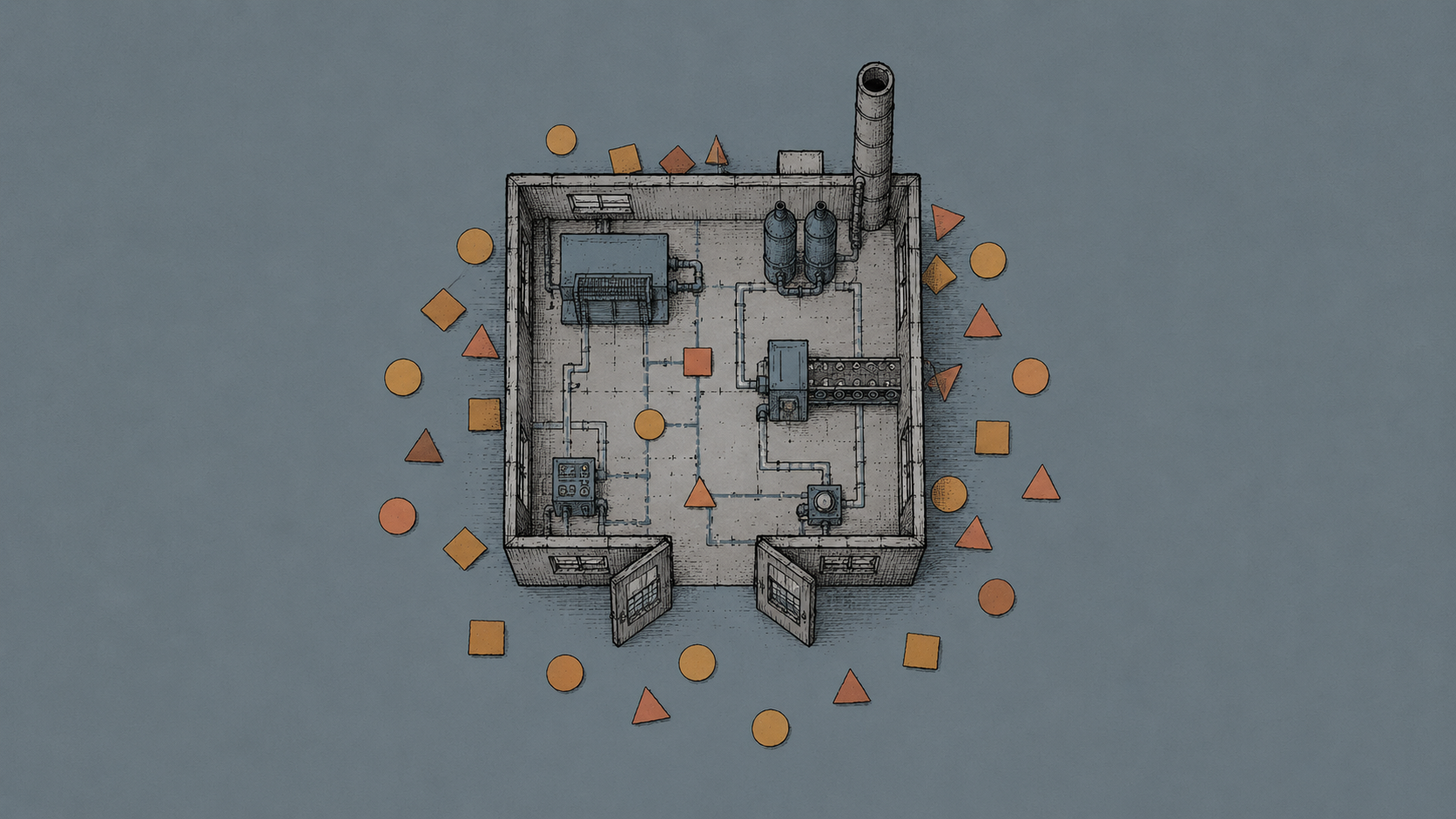
A manufacturing company is growing. The product is strong. The factory is running. The next step is obvious: hire more salespeople, get closer to the market, grow revenue.
So the sales team expands. People are out meeting distributors, visiting retail, talking to customers. They start picking up signals. A competitor has changed their packaging. A large buyer is shifting to a different specification. Customers in one region are asking for something the company doesn’t make yet.
Good information. Useful information. And almost none of it reaches the people who design the product, plan production, or set the company’s direction. The salespeople don’t have a forum. The production team doesn’t ask. The information enters the building and quietly disappears.
In 1990, Wesley Cohen and Daniel Levinthal published a paper in Administrative Science Quarterly that gave this kind of failure a name and a mechanism. They called it absorptive capacity — a firm’s ability to recognise the value of new external knowledge, take it in, and put it to use. The paper has been cited over 70,000 times. The organisations that need it most have largely never heard of it.
What the research actually found
Cohen and Levinthal started with cognitive science. New knowledge sticks when it connects to something you already know. A production engineer who has spent years working with a particular material will immediately grasp the significance of a new supplier’s specification sheet. A sales manager with no manufacturing background will look at the same document and see nothing useful. The difference isn’t intelligence. It’s scaffolding.
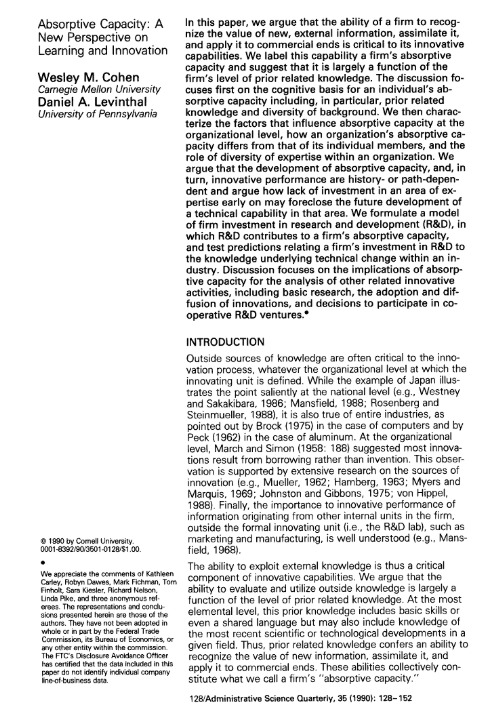
Opening page of the paper
Organisations work the same way. A firm can only absorb external knowledge that connects to expertise it has already built. Everything else is noise.
This creates a problem that compounds. If you’ve been investing steadily in understanding a market or technology, each new development is easier to recognise. If you haven’t, each new development is harder to even notice. Cohen and Levinthal called the extreme version “lockout.” Once a firm stops investing in its understanding of a fast-moving area, it may never catch up. Because the very expertise needed to recognise important signals is the expertise it allowed to atrophy. You can’t see what you’re missing, precisely because you’re missing it.
They also showed that organisational absorptive capacity depends on how knowledge is distributed across people, how communication flows between them, and who sits at the boundary between the firm and the outside world. When the people closest to the market and the people closest to the product share no common language, valuable knowledge falls into the gap between them. This pointed clearly towards organisational design. The literature that followed largely set that insight aside.
What came next
In 2025, Angelo Cavallo, Massimo Colombo, and Nicolai Foss picked up where Cohen and Levinthal left off. Their argument: absorptive capacity is fundamentally an organisational design problem. They identify two tasks inside absorption — gatekeeping (scanning and filtering external knowledge) and deployment (putting it to use) — and argue that how a firm combines or separates these tasks is what determines whether knowledge actually moves.
Think about the manufacturing company again. The salespeople are doing gatekeeping. The product and production teams are doing deployment. The two groups report to different people, sit in different buildings, speak different languages, and rarely meet. The architecture is broken.
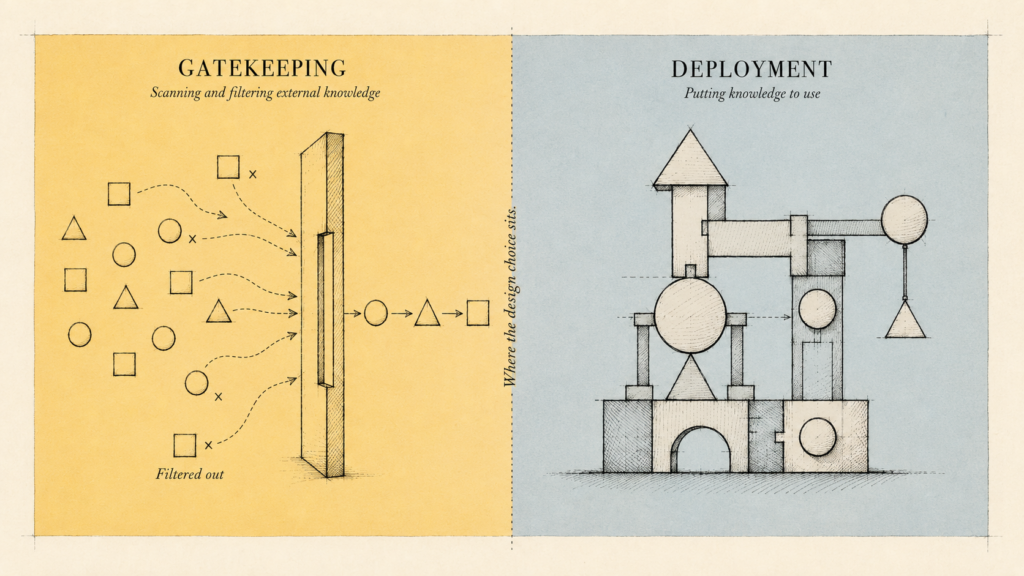
Cavallo, Colombo, and Foss’s core argument, drawn simply. Gatekeeping and deployment are distinct tasks. How a firm combines or separates them determines whether external knowledge actually reaches the people who can use it.
The problem extends well beyond sales and production. In most growing companies, the support functions — HR, Finance, Marketing, IT — operate almost entirely from the inside. They rarely visit a customer, walk a trade floor, or sit through a distributor meeting. They build their work on assumptions about a market they’ve never touched.
HR writes job descriptions for sales roles based on internal competency frameworks, when ten minutes with a distributor would reveal that the real skill gap is technical fluency in the product’s application.
Marketing produces campaigns built around features the factory is proud of, while customers are making decisions based on delivery reliability and after-sales support — things marketing has never heard them say first-hand.
Finance sets pricing and discount policies using spreadsheet logic, without seeing how a competitor’s pricing looks on a shelf. IT builds a CRM designed around what leadership wants to track, when the salespeople in the field find it irrelevant and stop entering anything useful within a month.
Each of these functions is making consequential decisions with no direct exposure to the environment those decisions are meant to serve. They are, in Cohen and Levinthal’s terms, locked out.
What this means if you are growing
The distance between the market and the people who act on what the market is saying — that is the variable to watch. This applies as much to the CFO or the head of HR as to the head of product. The question is whether the people making decisions about hiring, pricing, systems, and messaging have enough direct market exposure to know what’s actually changing.
Shared language is infrastructure. When sales and production cannot describe problems to each other — and when support functions cannot describe the market reality to themselves — the issue is structural. An HR manager who has spent a week on the road with the sales team writes a different job description. A finance analyst who has sat through a distributor negotiation builds a different pricing model. Some redundancy in expertise across functions is the price of staying open to what the market is telling you.
And the cost of stopping matters. The decision to pull back from a market segment or stop visiting a type of customer feels reversible. The research says it usually isn’t. By the time the importance is obvious, you are years behind.
The salesperson who comes back and says “customers are asking for something different” and gets no response. That isn’t a failure of communication. It’s a signal about how the organisation is built. Somewhere in the structure, the path between learning and doing has broken. The work is figuring out where.