Share


In 2016, two psychologists published a paper saying the most famous finding of their careers had been read wrongly for fifty years. The wrong reading was theirs. Steven Maier and Martin Seligman had watched “learned helplessness” travel out of a laboratory in Pennsylvania and into clinical psychology, leadership training, and everyday office talk. The neuroscience, they wrote, showed the mechanism running the other way round.
To see why that matters, start where they started.
The experiment
In 1967, Seligman and Maier were graduate students in Richard Solomon’s animal learning lab at the University of Pennsylvania. They were studying conditioning. They kept hitting an oddity. Dogs that had been through an earlier procedure would not learn a simple escape task afterwards. Most researchers would have called that noise. They decided it was the finding.
The design they built is the reason the study endures. There were three groups. The first got electric shocks it could stop by pressing a panel. The second got the same shocks, of the same length, at the same moments, with no way to stop them. That pairing is called a yoked design. Two animals are wired to the same circuit, and only one holds the switch. The third group got nothing.
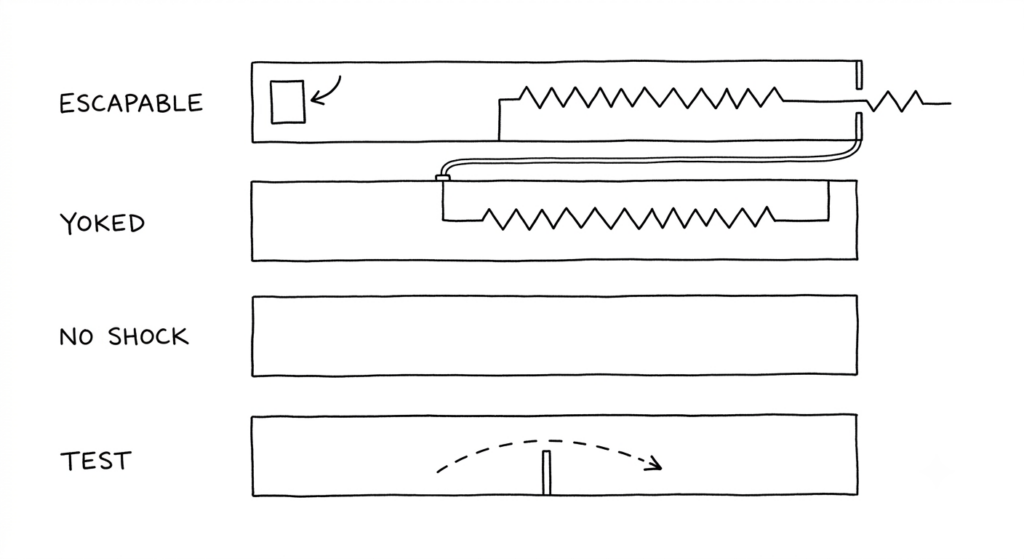
Three groups, two of them receiving identical shocks. Only one held the switch.
Every animal was then put in a shuttle box. A low barrier, a shock on one side, safety on the other. Groups one and three jumped over almost at once. About two thirds of group two lay down and took the shocks. The physical experience of groups one and two had been identical. Only control differed. So whatever caused the collapse was psychological.
The limits are worth naming. These were small samples of dogs, in a procedure no ethics committee would approve today. The human versions used gentler material. In 1975, Donald Hiroto and Seligman gave people bursts of noise they could not switch off, and puzzles that had no solution. Then they gave them a task they could easily have solved. Many did not try. Lower stakes, same shape.
From helplessness to explanatory style
The theory had a hole. Plenty of people meet adversity they cannot control and carry on anyway. In 1978, Lyn Abramson, Seligman and John Teasdale rebuilt the theory around the explanation a person reaches for after a setback. They named three questions. Is the cause me or the situation? Is it permanent or passing? And, is it everywhere or only here?
Take a lost pitch. One salesperson decides they are bad at selling, always have been, and it is showing up everywhere in their life. Another decides this pitch was wrong for this buyer this quarter. Same event. Two different futures.
This can be measured, and it predicts. In 1986, Seligman and Peter Schulman scored the explanatory style of life insurance agents at Metropolitan Life and then followed them. The more optimistic agents sold considerably more. They were also much likelier to still be in the job a year later, in an industry that loses about half its new intake every year. What survived the year was a habit of interpretation.
The reversal
Then the mechanism was mapped, and it embarrassed the original reading.
Long spells of adversity you cannot control switch on a cluster of serotonin neurons in the dorsal raphe nucleus. That is a small structure in the brainstem. The result is exactly the picture from 1967. Passivity, high anxiety, no attempt to escape. No learning is needed for this. It is the default mammalian response, and it is there from the first shock.
The part that does the learning sits in the frontal cortex. When an animal or a person acts and the bad thing stops, the ventromedial prefrontal cortex registers that link and sends a signal down that damps the brainstem response. That circuit gets stronger with use. Once trained, it is called on again by later trouble, including trouble that genuinely cannot be controlled.
So group one were the ones who learned something. Group two learned nothing. They simply never had the experience that switches the damping on. Helplessness is the starting position. Agency is the skill you acquire.
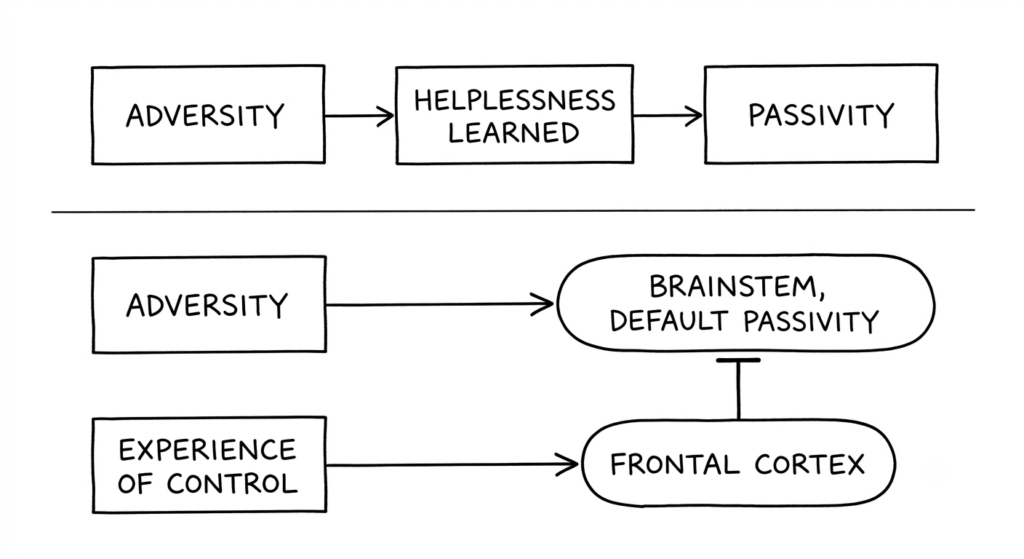
Above, the reading that stood for fifty years. Below, the one its own authors replaced it with.
Where the switch got turned off
That reading tells you what to look for. Not misery. The absence of any recent experience of acting and having something move.
The Ethics Centre’s 2018 review of Cricket Australia, commissioned after Cape Town, found staff who had stopped raising concerns. , found an organisation where what people said mattered and what actually happened had come apart. Stakeholders described a body that said one thing and acted otherwise. Once that gap is visible for long enough, people stop putting things on the record. Which is why telling everyone to speak up more was never the fix. The problem sat at the receiving end.
The same fade shows in the internal messages published by the US House committee investigation into the Boeing 737 MAX. The committee found sustained pressure to cut costs and hold the schedule against Airbus, and a company that withheld crucial information from its regulator, its customers and its pilots. Concerns existed inside the building. What the reward system pointed at was elsewhere.
This is also why turnarounds that open with strategy stall. When Tata took back Air India in January 2022, the fleet was the tractable part. The harder inheritance was decades in which decisions of consequence had been made somewhere else. A bold plan is a stimulus, and the circuit that answers stimuli had not fired in years. The early work was duller. The chief executive described the first six months as triage, tidying legacy problems and laying foundations, which is what rebuilding the link between effort and outcome actually looks like.
It runs the other way too. Western Australia’s Wheatbelt was written off again and again as marginal country. Then the no till and stubble retention systems taken up there from the 1990s onward turned it into some of the most productive dryland cropping in the world. By the mid 2000s the great majority of growers in the state had adopted the practice. The land had not changed. The reading of what could be changed had.
What it looks like from the inside
It does not feel like despair. It feels like maturity. The team still meets, still delivers, still speaks well of the strategy. What has quietly gone is the unprompted raising of problems. The awkward question in week two, rather than week twenty. People describe themselves as having grown realistic about what can change here.
The test is simple. Count the ideas that came up from below in the last quarter and were actually put into practice. If the answer is zero, your people already know it, and the quiet you are enjoying is the finding.
This is the fourteenth in a series on research that changed how we understand organisations and the people inside them, drawing on management, organisational behaviour, sociology and psychology. Each post takes one paper and asks what a working leader might do with it. The selection criterion is simple: it has to have been right about something important, and mostly ignored in the places that needed it. The previous post on belonging is here.