Share


The test was called the Harvard Test of Inflected Acquisition. It did not exist. There was no such test. There was no such thing as “inflected acquisition” to measure. But teachers at a primary school in California were told the test could find the children who were about to bloom. In 1965, the researchers gave the teachers a list of names. These pupils, they said, were about to improve quickly.
The children on the list had been chosen at random. One pupil in five, picked by chance, with no link to the test they had really taken. Eight months later, every child was tested again. The other children gained about eight IQ points that year. The children on the list gained about twelve. The youngest ones, aged six to eight, gained the most. Nothing had changed for these children. Their teachers had simply been told to expect more from them.
The study belonged to Robert Rosenthal and Lenore Jacobson. They published it in 1968 as Pygmalion in the Classroom. Rosenthal was a social psychologist at Harvard. For years he had studied a strange problem: researchers often found the result they were hoping to find. He thought this happened outside the laboratory too. Jacobson was the head teacher of the school — called “Oak School” in the book — and she let him test the idea on real children. The plan was simple. Choose at random who gets the label. Keep everything else the same. Then watch what the label does on its own.
The idea already had a name. In 1948, a sociologist at Columbia named Robert Merton wrote a short essay, “The Self-Fulfilling Prophecy.” A false belief, he said, can change the world and make itself come true. His example was a bank. Picture a healthy bank with plenty of money. One day a rumour spreads that the bank might fail. Worried customers rush to take their money out. So much money leaves that the bank really does fail. The false rumour has become true. The belief caused the very thing it predicted.
Rosenthal wanted to know how it worked. He and his team recorded hundreds of hours of lessons.
They found four ways that a teacher’s expectation shows, usually without the teacher noticing.
Warmth: more smiles, more eye contact, a kinder voice for the chosen pupil.
Harder material: they teach these children more, and more difficult, work.
More chances: they give them more chances to answer, and more time to think.
Better feedback: more praise, and clearer help when the child gets something wrong. A child who receives all four learns more. The expectation leaves the teacher’s head. It becomes behaviour, and the behaviour teaches the child.
Where it works, and where it does not
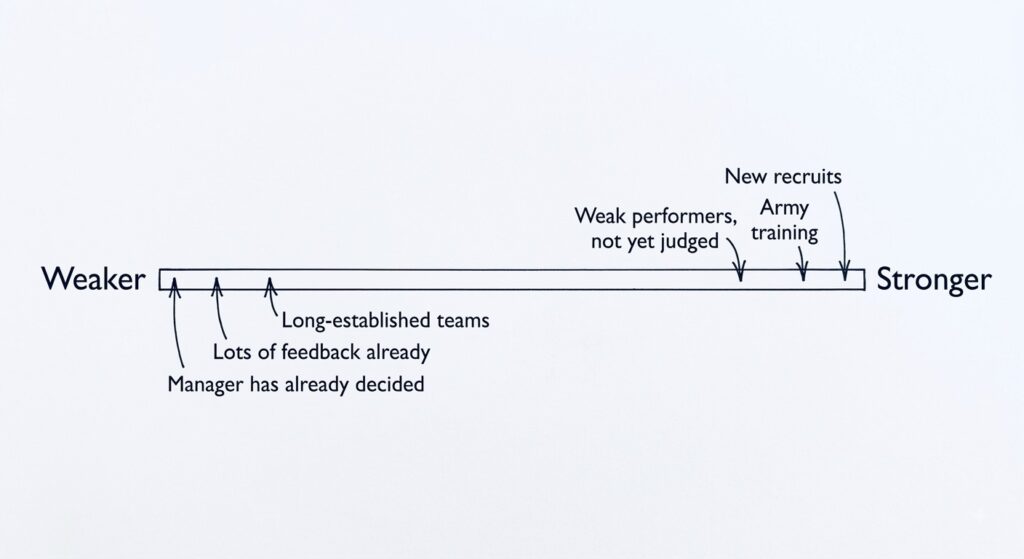
The effect has boundaries. It works where judgement is still forming, and fades where it has already set.
The finding did not stay clean, and it should not have. Critics soon questioned the IQ tests. The most useful correction came from Stephen Raudenbush. In 1984 he combined eighteen studies of this effect. He found the point that matters most for anyone who leads people. The effect depended on when the teacher received the label. If teachers were given it before they met the pupils, it worked. If they had already known the children for even two weeks, the effect almost vanished. A new expectation can change how you behave. An old one is already fixed. Later, Lee Jussim and others showed that in normal classrooms — where no one hands teachers a fake test — the effect is real but small. Much of the link between belief and result is teachers seeing talent correctly, rather than creating it.
Managers often miss this part. “Pygmalion” reached them as a simple message: believe in your people. The condition — that it works best on views you have not yet formed — quietly disappeared.
The person who brought it properly into work was Dov Eden, a work psychologist at Tel Aviv University. He tested on adults what the school study had only suggested. In the Israeli army, Eden and his team told instructors that some trainees had “high potential.” Again, these trainees were chosen at random. Those trainees then scored higher on real tests. Eden built a research programme on this through the 1980s. He also studied its two relatives: the Galatea effect, where you raise how much people expect of themselves, and the Golem effect, where low expectations push performance down
The evidence from workplaces is strong, and it is careful about where it applies. In 2000, Brian McNatt combined seventeen studies from real workplaces and found a large average effect — larger than most results in this field.
That same year, Kierein and Gold reviewed the research and agreed, with a smaller estimate. Both found the same pattern. The effect is strong in army training, with new recruits, and with weak performers no one has judged yet. It is weak in the office, weaker for women than for men, and weak wherever people already receive plenty of honest feedback. Expectation moves performance most when there is room to move it: when a person is new, untested, and still learning what is expected of them.
The pattern since
You can see the four channels working outside the classroom.
In Indian companies, the label is a college. A top college name — an IIT or an IIM — sends a graduate to the best first projects, the senior mentors, the difficult tasks. The name on the CV opens the door. Behind the door is the training that makes the name look deserved.
Around the world, the label is the “high-potential” list. Some companies call it the A listers. A company marks perhaps one in twenty managers as “high-potential.” It then gives those people the most training, support and challenging work. They get promoted. Some would have done well anyway. Some do well because the list chose them — and the company then treats their success as proof that the list was right.
The harder half is the Golem effect, because it uses the same process in reverse. Quietly decide that someone is weak, and you give them less time to speak, less feedback, and less interesting work. They do less. Their weak results confirm your view, and you never see that you helped cause them. It rarely feels like a choice. It feels like fair judgement.
So here is the question for your next meeting. Set aside whether you believe in your people. Ask something smaller and harder: which of your team have you already marked as limited? And if you were wrong about one of them, what would you be doing differently that you are not doing now?
This is the tenth in a series on research that changed how we understand organisations and the people in them. Each post takes one study and asks what a working leader might do with it, drawing on management, organisational behaviour, sociology and psychology. The selection criterion is simple: it has to have been right about something important, and mostly ignored in the places that needed it. The previous post on motivation is here.