Share


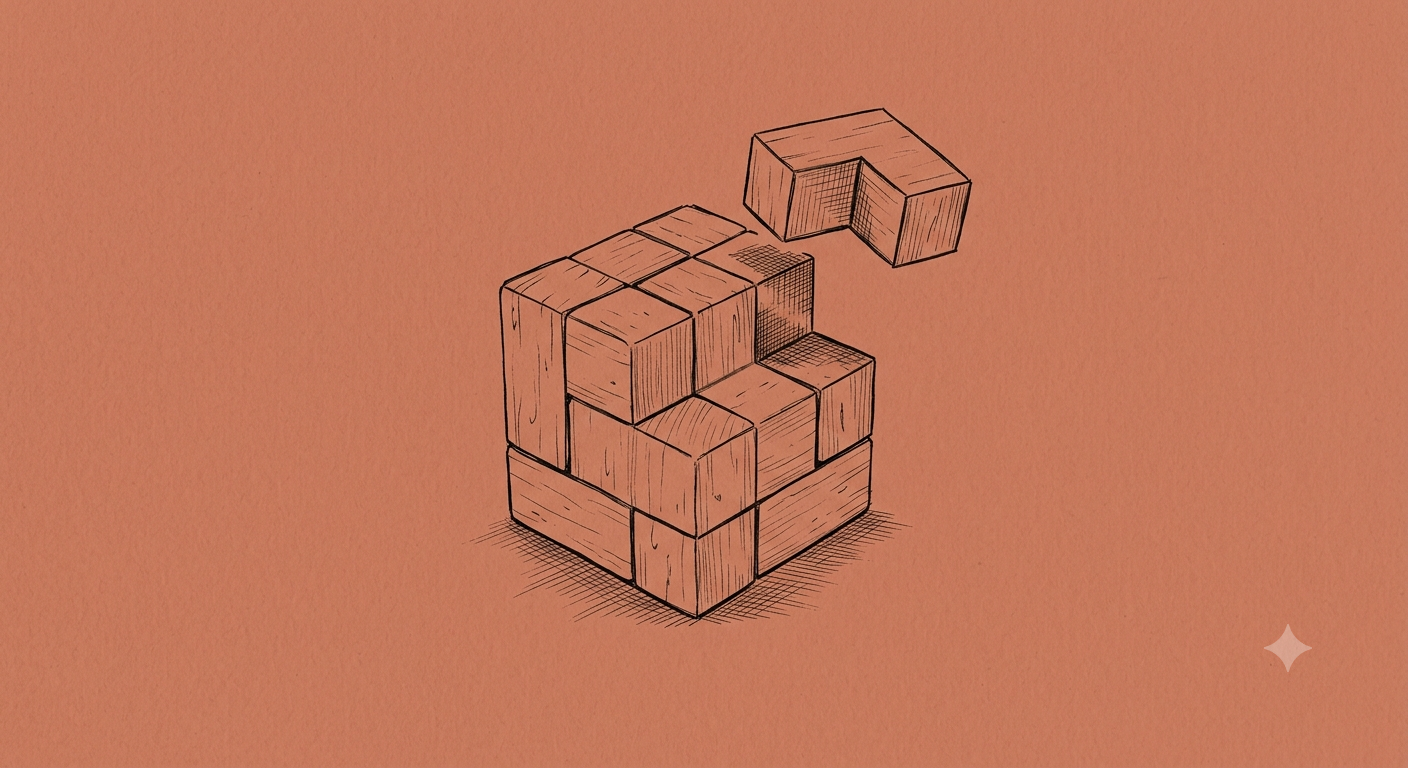
A university student sits alone with a puzzle called the Soma cube: seven odd-shaped blocks that fit together into a surprising number of forms. He has been asked to copy a few of them from drawings. Then the experimenter says he must step out to enter some data and will be back shortly. On the table are a few magazines. Behind a one-way mirror, someone is timing how long the student keeps playing now that nobody is asking him to.
That eight-minute stretch, repeated across three sessions in 1971, is one of the quietly consequential measurements in the study of work. It belongs to Edward Deci, then a young psychologist at Carnegie Mellon in Pittsburgh. He wanted to know something simple. If you pay people to do a thing they already enjoy, what happens to the enjoyment?
The experiment
Deci ran it cleanly. Every student solved puzzles across three sessions on separate days. One group was paid a dollar for each puzzle solved, and only in the middle session. The other group was never paid. The measure that mattered was the free-choice period: alone with the puzzle and some magazines, who kept playing? In session one the two groups behaved alike.
After the paid group had earned money and then had it taken away, their free-choice interest dropped. The unpaid group’s held steady. Being paid, and then unpaid, had made the puzzle less worth doing for its own sake.
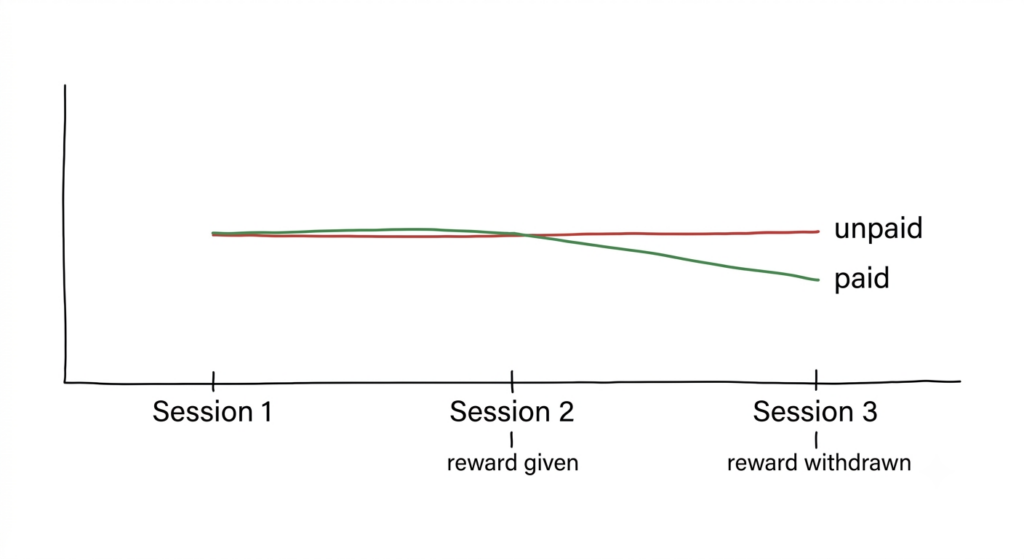
Paid, then unpaid. Once the money stopped, the paid group spent less of their free time on the puzzle than the group that was never paid at all.
What the reward does
Deci had watched intrinsic motivation erode in real time: the pull to do something because the doing itself satisfies. His explanation turned on where we locate the cause of our own behaviour. Do a thing for its own sake, and the reason sits inside you.
Add a reward, and the reason can migrate outward, onto the money. Take the money away, and the internal reason has already been crowded out. A reward does not sit on top of the interest. It can quietly replace it.
Out of the lab
The lab result might have stayed a curiosity. Two years later it walked out of the lab. Mark Lepper, David Greene and Richard Nisbett, watched nursery-school children who plainly loved drawing with felt-tipped pens. Some were promised a “Good Player” certificate for drawing. Others were handed the same certificate afterwards, unannounced. A third group got nothing. Weeks later, in ordinary free play, the children promised the reward drew less, and with less evident pleasure, than the rest. The surprise-reward children were unaffected. What corroded the interest was the expectation, the drawing done in order to earn the prize.
They named it overjustification: give people too many reasons to do what they already wanted to do, and the original reason weakens.
The long argument
The finding was then argued over for two decades. In the mid-1990s Judy Cameron and David Pierce pooled the studies and judged the harm small and fragile, close to a myth, with rewards on the whole doing no damage. In 1999 Deci answered, with Richard Koestner and Richard Ryan, through a meta-analysis of 128 experiments. The picture that survived the arithmetic was more precise than either camp had wanted.
Verbal rewards, such as praise and useful feedback, tended to lift intrinsic motivation.
Unexpected rewards did little either way. The rewards that reliably corroded interest were the tangible ones people came to expect and saw as strings attached to the task: do this, get that. Those are the rewards most workplaces are built from.
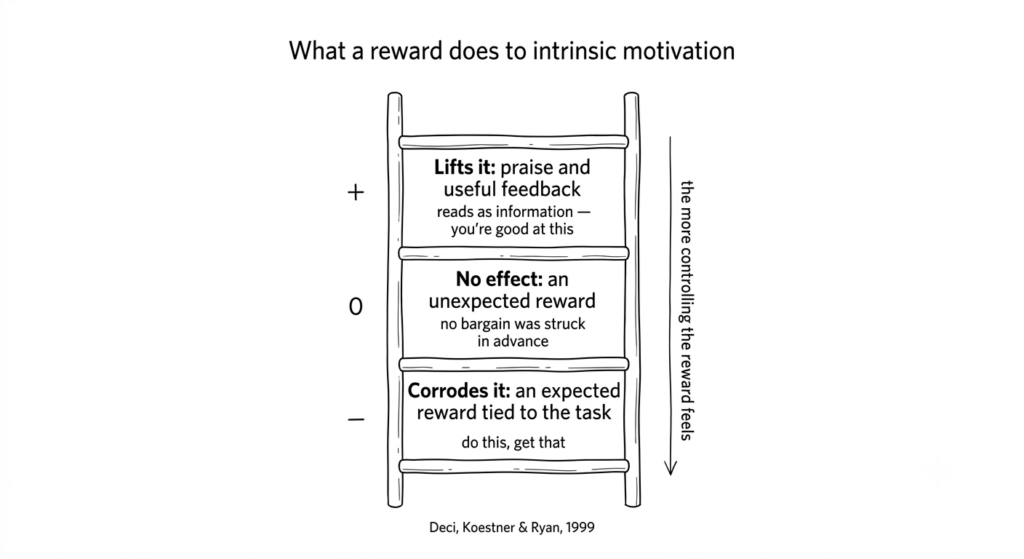
Rewards do not all behave alike. Praise and useful feedback tend to lift motivation; an expected reward tied to the task is the kind that quietly corrodes it.
Motivation has a texture
Out of this grew Self-Determination Theory, the framework Deci and Ryan built at Rochester. A reward, it holds, carries two messages at once. One says you are good at this, which feeds motivation. The other says your behaviour is being steered from outside, which starves it. People keep supplying their own effort where three things are protected: a sense of choice, a sense of growing competence, and a sense of connection to others. Pay that strips away the choice is pay that works against itself.
The pattern since
The effect shows up most starkly wherever money enters a space that had been running on something else.
In Australia, during the 2019–20 bushfires, the federal government offered volunteer firefighters up to $6,000 for extended time on the fire ground. The government was quick to frame it as cover for lost income, wary of being seen to put a wage on service. Some veteran volunteers bristled anyway, arguing money cut against the neighbourly ethic the service was built on. They were describing overjustification from the inside.
In India, the move away from paid blood donors tells the same story at national scale. Following a 1996 Supreme Court judgment, professional blood-selling was outlawed by 1998 and the country turned to voluntary, unpaid donation. Safety drove the reform, since paid donors concealed risk. Underneath it sat an older observation: a voluntary system holds a kind of motivation a paid one cannot, and paying can drive the willing donor away.
Globally, the cleanest demonstration came from ten daycare centres in Haifa. Economists introduced a small fine for parents who collected their children late. Late pickups went up. The fine had turned a matter of conscience into a purchased service, and once lateness had a price, more parents were content to pay it. Removing the fine later did not undo the change.
What a leader can ask
None of this argues against paying people. It argues for noticing what the pay is doing to the reasons underneath the work. A sales commission, a gamified target, a leaderboard, a bonus tied to open-source contribution: each can lift output and quietly reprice work that someone had been doing partly for its own sake. The useful question is narrow. Is this reward telling someone they are good at the work, or telling them the only reason to do it is the reward? The first sustains motivation. The second spends it.
This is the eighth in a series on research that changed how we understand organisations and the people in them. Each post covers one paper or study, clearly described, and what a working leader might do with it. The work comes from management, organisational behaviour, sociology, and psychology. The selection criterion is simple: it has to have been right about something important, and mostly ignored in the places that needed it. Check out the previous post on Power here.