Share


In 2006, a group of organisational psychologists published a finding that most office workers could have told them for free. Meetings make people tired. Not in the way that hard work makes people tired. In the way that helplessness makes people tired.
Steven Rogelberg and his colleagues had been studying meeting load and employee wellbeing for years. What they found was precise and slightly uncomfortable. The number of meetings a person attends predicts their exhaustion and job dissatisfaction independently of how many hours they work overall. It is not the workload. It is the meetings within the workload. The meeting itself is the stressor.
The paper was published in the Journal of Applied Psychology. It has been cited hundreds of times. The average number of meetings in most organisations has continued to rise.
What the research actually found
Rogelberg’s team distinguished between two kinds of meeting demand. The first is simple volume, how many meetings, how long. The second is what they called subjective experience, how the person in the meeting actually feels about being there.
Both matter. And the second matters more.
An employee who attends many meetings but finds them useful reports significantly lower exhaustion than an employee who attends fewer meetings but experiences them as a waste of time. The damage is not simply in the hours consumed. It is in the feeling of time taken without return.
This finding has a sharp implication. Reducing meeting frequency helps. Improving meeting quality helps more. And the thing that determines quality, in Rogelberg’s data, is not the agenda or the room or the technology. It is whether the people in the meeting believe their presence made a difference.
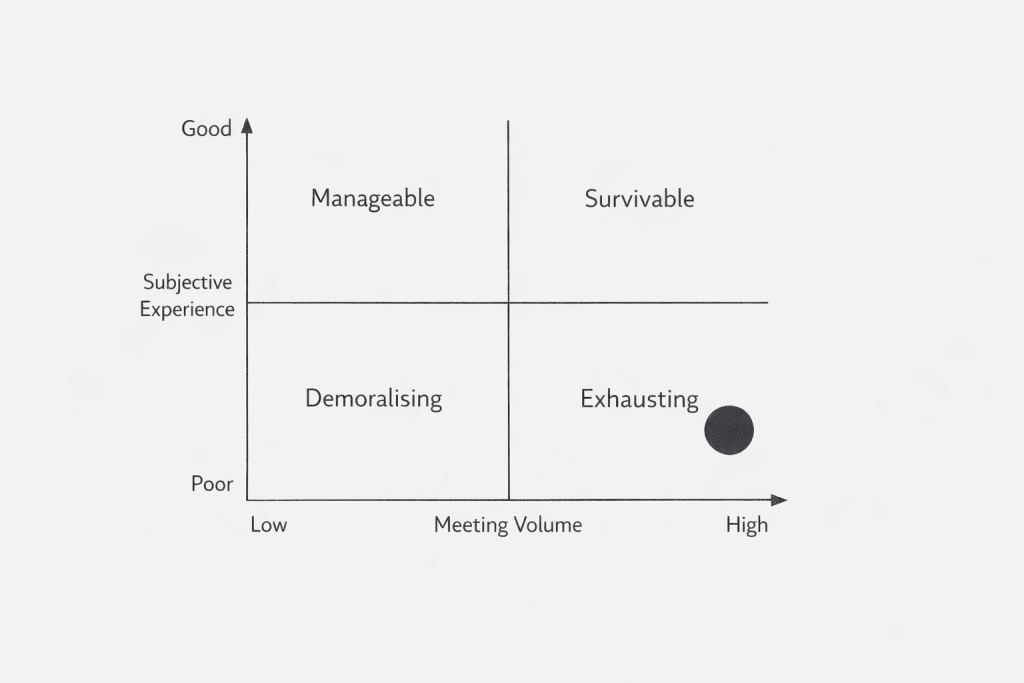
High volume and poor experience. That is where most organisations live.
Why meetings multiply anyway
The research identifies something most productivity advice skips entirely. Meetings do not proliferate because people are careless with time. They proliferate because they solve real problems for the people who call them, just not the problems everyone assumes.
A meeting provides the caller with information, visible alignment, and the feeling of having acted. These are genuine needs. The difficulty is that they are the caller’s needs, and the costs, the hour taken from twelve people, the momentum broken, the afternoon fragmented, are distributed across everyone else and therefore invisible in any single person’s accounting.
This is why calendar audits and meeting-free Fridays produce temporary relief and little lasting change. The structure that generates meetings remains intact. The needs that meetings serve go unaddressed. The calendar fills again within a quarter.
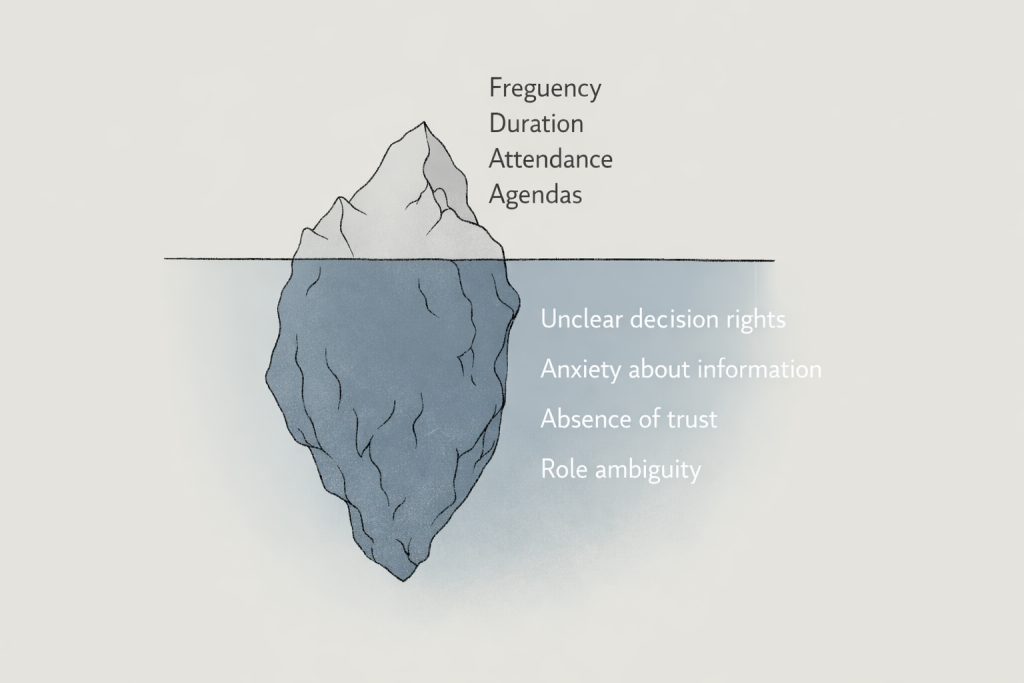
Every meeting intervention targets the visible part.
One finding worth sitting with
Rogelberg later described a senior leader who prided himself on an open-door policy and a full calendar. Every direct report had access. Every question got a meeting. The leader experienced this as responsiveness. The team experienced it as the inability to make a decision without permission.
The meetings were doing emotional work the organisation had never acknowledged and therefore never addressed. The leader’s anxiety about being uninformed. The team’s anxiety about acting without cover.
Changing the calendar did not help. Clarifying decision rights did.
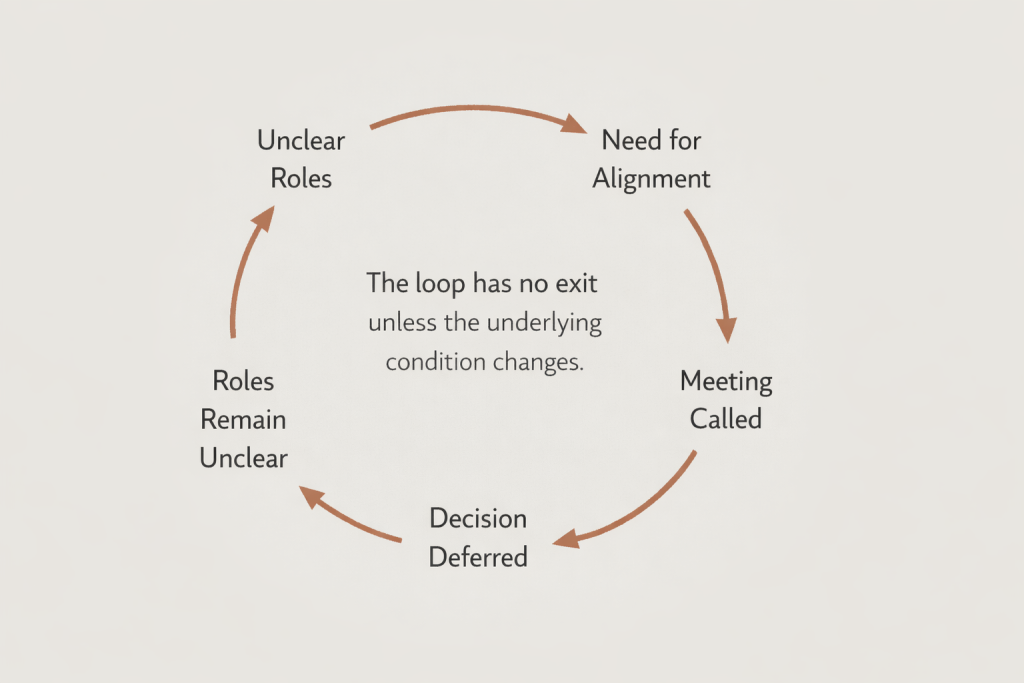
The loop that calendar reform cannot break.
What this means if you are running something
Before you redesign your meeting culture, ask what your meetings are actually doing. Not what they are supposed to do. What they are doing.
If they are resolving genuine coordination problems, the question is efficiency. If they are managing anxiety, substituting for unclear roles, or providing cover for decisions nobody wants to own, efficiency is the wrong question entirely.
The meeting is rarely the problem. It is where the problem becomes visible.
Rogelberg’s 2006 paper is available through most university libraries and Google Scholar. The 2007 MIT Sloan companion piece is ungated and worth reading alongside it. Both take under an hour together.
Read More
Rogelberg, S. G., Leach, D. J., Warr, P. B., & Burnfield, J. L. (2006). “Not another meeting!” Are meeting time demands related to employee well-being? Journal of Applied Psychology, 91(1), 83–96.
This is the second in a series on research that changed how we understand organisations and the people in them. Previous post is here. Each post covers one paper or study, clearly described, and what a working leader might do with it. The work comes from management, organisational behaviour, sociology, and psychology. The selection criterion is simple: it has to have been right about something important, and mostly ignored in the places that needed it.