Share



As 2025 draws to a close, it is the perfect moment to pause and reflect. At Flyntrok, we believe the most valuable lessons are found in those moments of reflection. That is why we offer you our End-of-Year Reflection Series.
We have curated and invited experts across diverse fields to share their perspectives on the defining moments and trends of 2025. Each brings a unique lens to their respective areas ranging from the world of HR to leadership and research. This series isn’t just about looking back; it’s about gaining the perspective you need to make sense of a changing world and chart your course for 2026 with intention.
Deepa Premkumar designs and leads organisational change efforts across different industries. With expertise in Transformation, Analytics, and organisational development she combines change management and a genuine curiosity about how people experience transformation. She has been invited to speak on evolving work trends at forums and channels including CNN, CNBC, and NDTV. Her lens of 2025 explores how things have changed from 5 different dimensions.
Over to Deepa
Five Lenses on 2025: The Year Work Transformed
We got more productive and more exhausted. More automated and more human. 2025 was a year of contradictions that somehow all made sense. That is what I kept seeing everywhere. To make sense of it, I have been looking at five lenses / questions:
- What gets done? (Work),
- Who does it? (Workforce),
- Where do they do it? (Workplace),
- And How? (Technology, Culture, Process).
Here is what 2025 revealed through each lens.
Lens 1: The Workforce in 2025
A new generation is taking over
Gen Z and Millennials are now the dominant force in our workplaces. Together, they will comprise nearly three-quarters of the global workforce by 2030. But here is what we must understand: they carry distinct burdens that previous generations did not face at the same scale.
The mental health data is stark. Gen Z shows a 44.5% rate of major depression diagnosis, compared to 35.8% for Millennials, 19.2% for Gen X. COVID interrupted their formative years—education, milestones, critical development periods. The paradox? They’re earning more than their parents did at the same age, yet 65% don’t feel financially secure.
The challenges are not really in their bank accounts—it is in their anxiety, depression, and sense of perpetual instability. This matters because their expectations, resilience, and relationship with work all carry this weight. We will need to lead differently.
Skill-based hiring has become predominant
Companies do not hire for a degree earned years ago anymore. They hire for the skills you have today. Tech companies are dropping degree requirements entirely. Considering the impact of AI and shortening shelf life for skills, this shift makes sense.
Fractional leadership roles have gained traction
Companies are hiring fractional CXOs and Leadership roles. At Flyntrok itself the number of requests for fractional CHRO support has increased considerably in 2025. Leadership does not require full-time presence to create full-time value.
Lens 2: The Workplace in 2025
Flexibility Wins, Negotiation Continues.
After the back and forth between return to office and remote work, 2025 saw hybrid work settle as the dominant model. Flexibility won. The data backs it up: 52% of workers are hybrid.
But here is the tension: hybrid remains a constant negotiation. Which days am I in? Who else will be there? Camera on or off? These are not resolved questions—they are daily negotiations.
Plus, both these micro trends are real!
- Hybrid creep: The number of days in office are inching up. 39% now work three days in office & 34% work four days, both numbers are up from previous years.
- And then there’s coffee-badging: 43% of hybrid employees admit to briefly showing up just to check the attendance box before working elsewhere.
This tells us while the model is hybrid. The experience is still unsettled. Leaders who treat hybrid as a solved problem are missing the daily friction their teams navigate—and losing trust in the process.
Lens 3: Work Itself in 2025
From execution to orchestration.
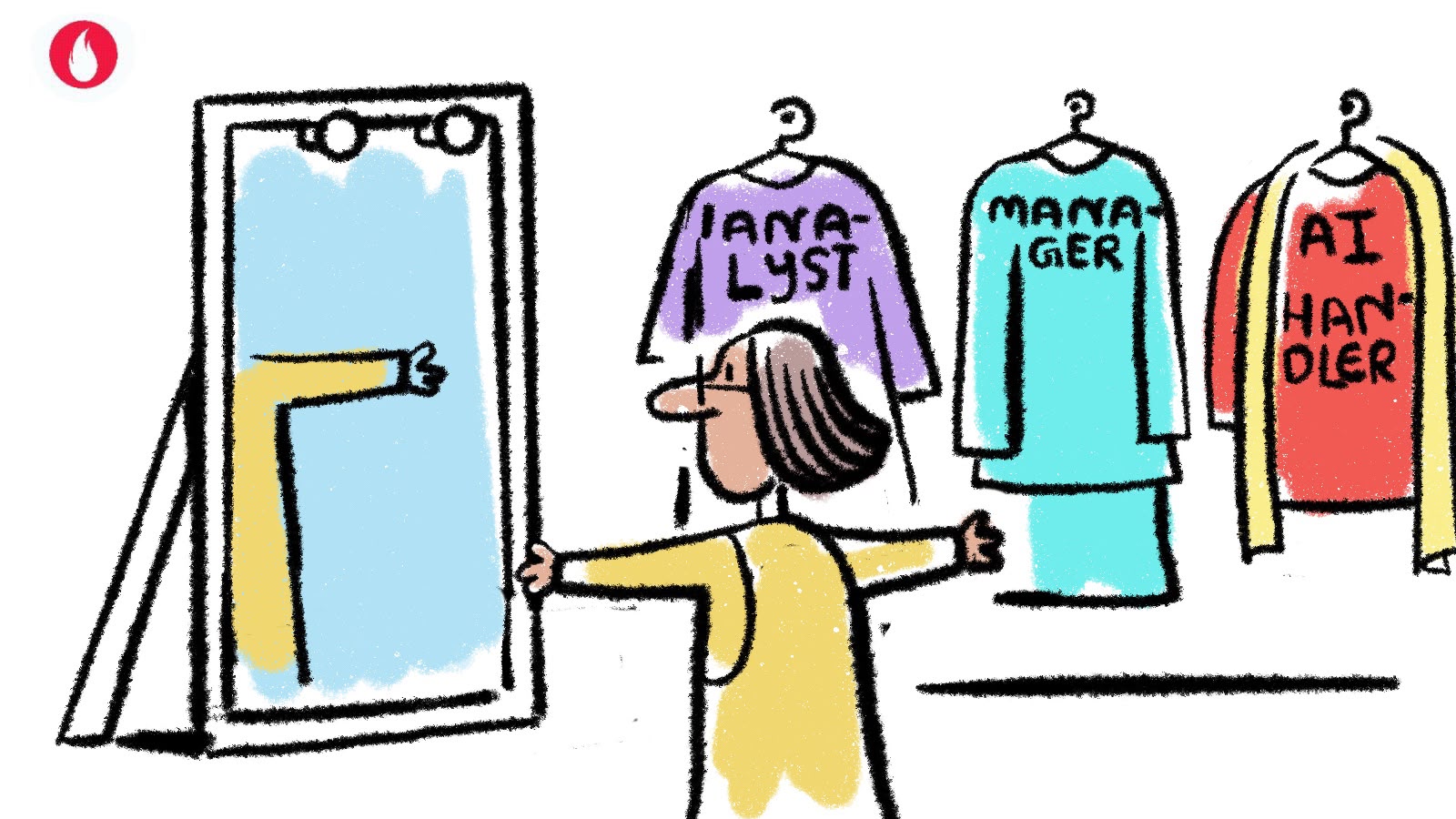
We used to go to office and deliver tasks. Now, with AI embedded everywhere, work is about orchestrating—managing between different AI tools, humans, async and sync channels.
Here is an example that is probably true for many of us: We no longer work with one AI model. We are carrying three or four LLMs—Claude for one task, ChatGPT for another, a specialized model for something else. We are comparing outputs, reviewing output, testing approaches, and choosing what ships. That is orchestration.
The AI Identity Crisis: What Do We Do With Our Time?
But orchestration creates a deeper challenge—one that is hard to name but impossible to ignore.
Orchestration feels like cheating. Like we are taking shortcuts. Like we are not doing what we are supposed to do. We have been trained to value execution—doing the work ourselves. Delegation to AI triggers something in us: Is this really work? Am I still adding value?
Add to this: we have not figured out what our next arc of growth is. We freed up time by delegating to AI, but we do not know what to do with that time. So, we end up doing more of the same. Creating a loop of overwork and fatigue rather than using the freed capacity for higher-value work.
This identity crisis—the discomfort with orchestration, the uncertainty about our next evolution—is the hidden cost of AI adoption that we are not having enough conversations about.
The Manager Paradox
The curious paradox we are noticing: as AI and technology become more integrated into individual contributors’ roles, managers’ roles have become even more emotion- and development-focused.
As AI handles more technical work, managers must hold the flag of emotions and development even more strongly. They are the human interface technology cannot provide yet. The more automated work becomes, the more ‘human’ leadership must be
Lens 4 & 5 : The How We Work
For 2025, am picking two distinct ‘How’ that have had an impact on work – AI and Agile
Lens 4 – Agile: Context Over Ceremonies
Agile has been around 25+ years and people keep writing its obituary, every now and then. Yet the State of Agile report 2025 says over 90% of organisations use some Agile practices.
But how they are using it has shifted.
- Companies are no longer interested in following ceremonies, but rather are adapting practices to suit the outcomes they seek to create. They are not focussed on “Did we answer the three questions in standup?” but “What will give us better results?”
- Agile roles now demand technical expertise alongside facilitation skills. Scrum Masters and Agile coaches could be pure facilitation roles earlier. Not anymore. These agile roles now need both technical depth plus facilitation capability.
At Flyntrok, we have always believed facilitation is a key leadership skill. Not a standalone specialisation. This shift validates that belief: leaders need technical prowess and facilitation capacity to lead teams into the future.
Lens 5 – AI: From Novelty to Trusted Collaborator
The biggest shift? How AI evolved—and how we had to evolve with it.
Remember 2022-2023 when Generative AI emerged? Unreliable. Hallucinated constantly. More novelty than utility.
2024 brought improvement. You could give AI tasks. It needed oversight, but it got better at drafting and research. A tireless apprentice needing constant supervision.
2025 saw AI become a trusted collaborator. Reliable enough for substantial work. We moved from line-by-line review to spot-checking. It handles complex reasoning now. The numbers tell the story: 77% use AI to save time and reduce manual effort. 41% use it to accelerate planning and development. And autonomous agents are emerging—not fully mature, but evolving toward delegating entire workflows, not just discrete tasks.
That means that we have had to change our mindsets – treating AI as a thinking partner. In 2025 we had to learn how to get better at defining outcomes and release control over the step-by-step processes. This meant getting comfortable with ambiguity.
The Thread Running Through It All
One pattern emerges across these five lenses:
2025 was the year work stopped being about following established processes and started being about navigating constant evolution.
Gen Z is not following traditional career paths. Hybrid is not settled. Work shifted from execution to orchestration. Agile moved from framework adherence to contextual outcomes. AI moved from tool to collaborator.
Work in 2025 became more human in its demands (empathy, emotion, adaptation) even as it became more technological in its tools.
—
What This Means for Leaders
The leaders who will thrive are not those who have mastered AI or perfected hybrid. They are the ones who can hold both: technological fluency and deep human capability.
Organisations that invest only in tools without developing their people’s capacity to orchestrate, adapt, and lead through ambiguity will find themselves with impressive infrastructure and disengaged teams. The tools will not compensate for the absence of leadership.
The question for 2026 is not “What’s the next tool?” It is “How do we develop leaders who can navigate constant evolution while keeping their teams whole?”
That is the work that matters.
We invite you to look back at 2025 through your own experiences as you chart the work that matters in 2026. A personal reflection guide (New Beginnings) is available for you at flyntrok.com/point-of-view.