Share


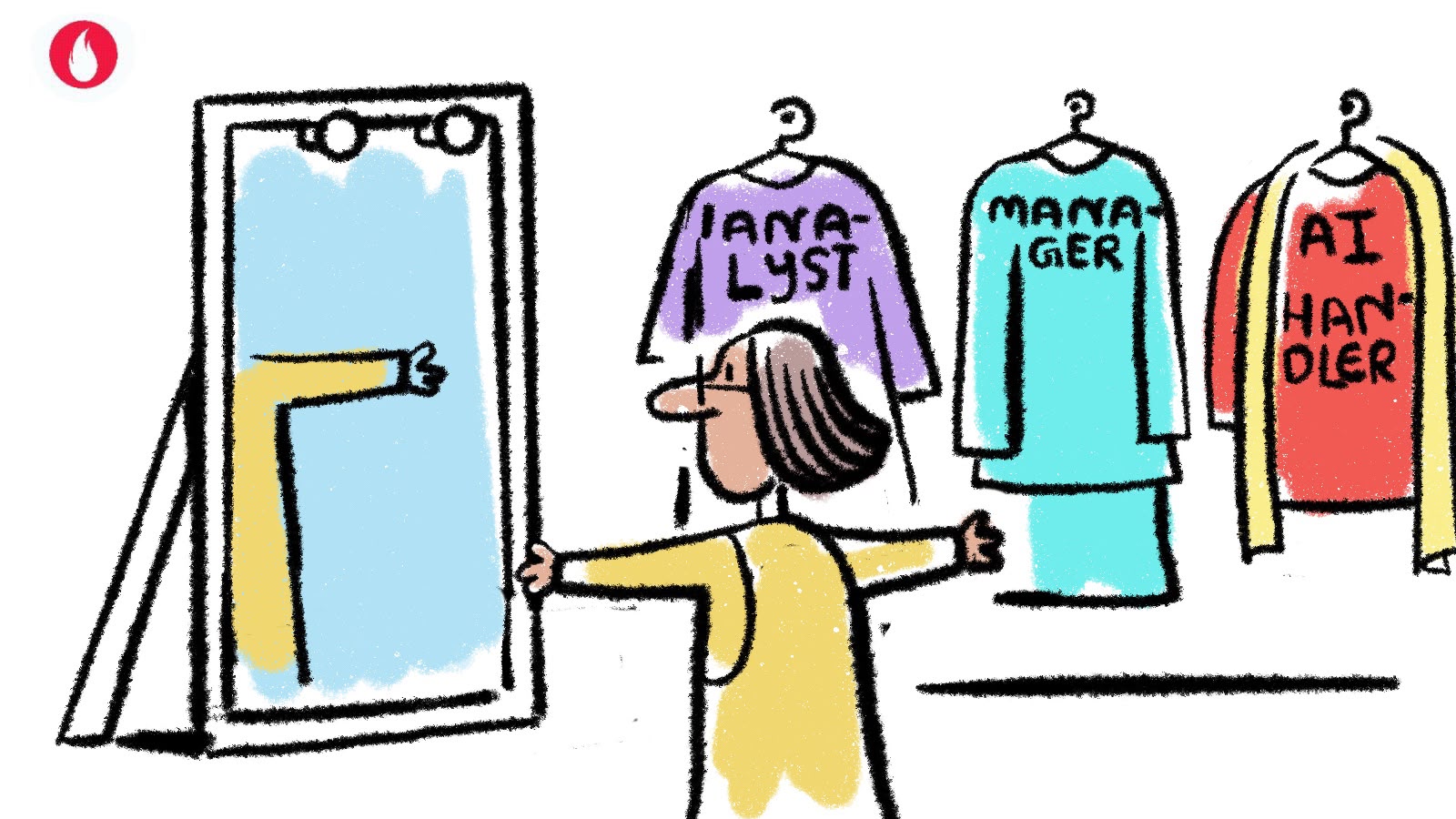
Have you noticed typical introductions when you meet someone? “Hi, My name is ..so and so…. and i am ..role designation... at ..company”. Our role designations have got intertwined with who we are. But scratch that surface a bit and ask them what they really do, and they will invariably respond with a set of tasks.
Many times, what we do is an easier question to answer than who we are. Organisations compound this with the way Job descriptions are written. JD’s are a set of tasks and not about impact. Yes, tasks give us a sense of accomplishment. And over the years, maybe without meaning to do so, we have come to define ourselves with the tasks we do!
Which is why AI automating tasks at such speed is a moment of reckoning and reflection.
The Question Nobody Warned You About
Picture a software engineer who has spent fifteen years defining herself through the code she wrote. Now, AI begins writing the code. She finds herself staring at a screen one afternoon, wondering something she has never wondered before. If I am not the one writing this code, what exactly am I here for?
This question is starting to get more and more and more common. It is uncomfortable and disorienting. But this is not a productivity or an execution focussed question but rather a question of identity.
Why Tasks & Execution?
Tasks and Execution have a lot going for it. Tasks are urgent, visible, and satisfying. It produces something tangible. And in most organisations, the systems, the metrics, the performance conversations are built around outputs. As Cal Newport has observed, organisations tend to measure and reward what is easy to see. Tasks completed, emails answered. One thoughtful and hard conversation is harder to point to than a few smaller problems resolved.
Execution is familiar ground. It is where the professional identity was built.
This is where generative AI becomes genuinely interesting. Not just as a productivity tool, but as something that surfaces a deeper question about role and identity.
Generative AI is compressing the execution end of the spectrum. Reports, emails, data summaries, routine analysis — tasks that once took hours now take minutes. When that compression becomes large enough to notice, something shifts. Not just on your calendar. The question of what you are really here to do starts to surface.
That question is not a role design question. It is an identity question. And it is precisely because it is an identity question that many leaders, even when they recognise it, find it difficult to act on.
AI & Our Identity?
A teacher whose lesson plans are drafted by AI is still the one who knows which student needs a push and which one needs room to breathe. A lawyer whose first-draft contracts are generated in seconds is still the one who knows which clause will actually matter in a dispute three years from now. The task was never the whole story. It was the part that was easiest to see.
The software engineer in this post reminds me of parents facing an empty nest! For decades, parenting was built around a list of never ending tasks. Packed lunches, school pick up, homework help, bedtime. Then kids grow up and the task list empties out. The parent feels lost and disoriented, much like the engineer staring at the screen. But eventually, most parents realise something. Tasks are gone, but being a parent was never only the task list. It was always the thing underneath it; the worry, the care, the way they show up. The role did not disappear when the task did. It was easier to see the tasks than the role, so the tasks got mistaken for it.
This is what we are up against right now. Not a loss of identity, but a case of mistaken identity. The task and the self, held so close together, for so long, that it gets hard to tell where one ends and the other begins. Ruben Hassid, an AI strategist, took a similar question to Demis Hassabis, the Nobel prize winner and CEO of Google DeepMind. His reflections pointed to the same things – maybe screens and tasks were never the whole point.
Tasks are not without value. They give us real accomplishment and a way to measure a day well spent. But being useful is not the same as being who you are. It never was.
The Reframe AI is helping us with
Here is the part I keep coming back to. Maybe AI is not taking something away from us. Maybe it is handing something back.
AI is forcing us to stop taking the shortcut of tasks to define ourselves and our identities. Once our identity is separated from the tasks we complete, we do not rebuild it by trying harder at the next task. We question ourselves in curious and exploratory ways. Where does my sense of value come from?
That is exactly where this series goes next. Not what happens when the task disappears. But how an identity gets built in the first place, and how deliberately we can go about building it again.