Share


In 1972, twenty-eight undergraduates walked into a psychology lab at Temple University to play manager for an afternoon. Each was told they would supervise a worker on a simple task, from a separate room, using nothing but written instructions. Half of them were handed something extra: a menu of institutional powers. They could threaten the worker’s pay. They could recommend a transfer. Plus, they could dangle a bonus. The other half had no such tools. They could only ask.
The psychologist running the study was David Kipnis, and the question he was chasing had bothered philosophers for centuries without ever being tested in a lab: does power actually corrupt, or does it only look that way in hindsight, from scandals we already knew the ending of?
Kipnis built a simulated organisation to find out. His subjects never met their “subordinates” in person. The workers weren’t even real people responding freely, they were part of the experimental set-up, which let Kipnis isolate one thing cleanly: what having institutional power does to the person holding it, independent of who is on the other end.
The results were consistent enough to name. Subjects given power used it, almost without exception, even when asking nicely would have worked just as well. They rated the subordinate’s work lower than subjects without power did, despite identical output. They credited themselves for any good performance, as though their own authority had produced it, rather than the worker’s effort. And they began describing the worker in the language of an object to be managed rather than a person to be persuaded. Plus, they wanted less personal distance from the powerless worker, not more, which sounds counterintuitive until you notice what it actually meant: contact on their terms, not the worker’s.
Being handed authority was enough
Kipnis called this the metamorphic effect of power. Power doesn’t reveal character so much as rearrange it. Four years later, with colleagues Patricia Castell, Mary Gergen and Donna Mauch, he ran a fuller version of the study and found the same pattern held even when the “powerholder” had done nothing to earn the role. Being handed authority was enough. Nobody needed to want it.
The study has an obvious limitation, one Kipnis never hid. It used undergraduates in a one-off lab task, not managers making decisions that mattered over years. A brief, artificial hierarchy is not the same thing as a career built inside one. What the lab could isolate cleanly, the real world complicates with reputation, relationships and consequence.
Later researchers picked up exactly that thread. Susan Fiske, in 1993, argued that power’s real damage often isn’t malice. It’s attention.
Think about where attention naturally goes. An employee has good reason to read the boss’s mood correctly, because a promotion or a bad week might turn on it. The boss has far less reason to read the employee’s mood correctly, because so little rides on it from their side. Attention follows consequence. Once the consequence shrinks, so does the effort to look closely, and the powerful simply stop reading the people below them as carefully.
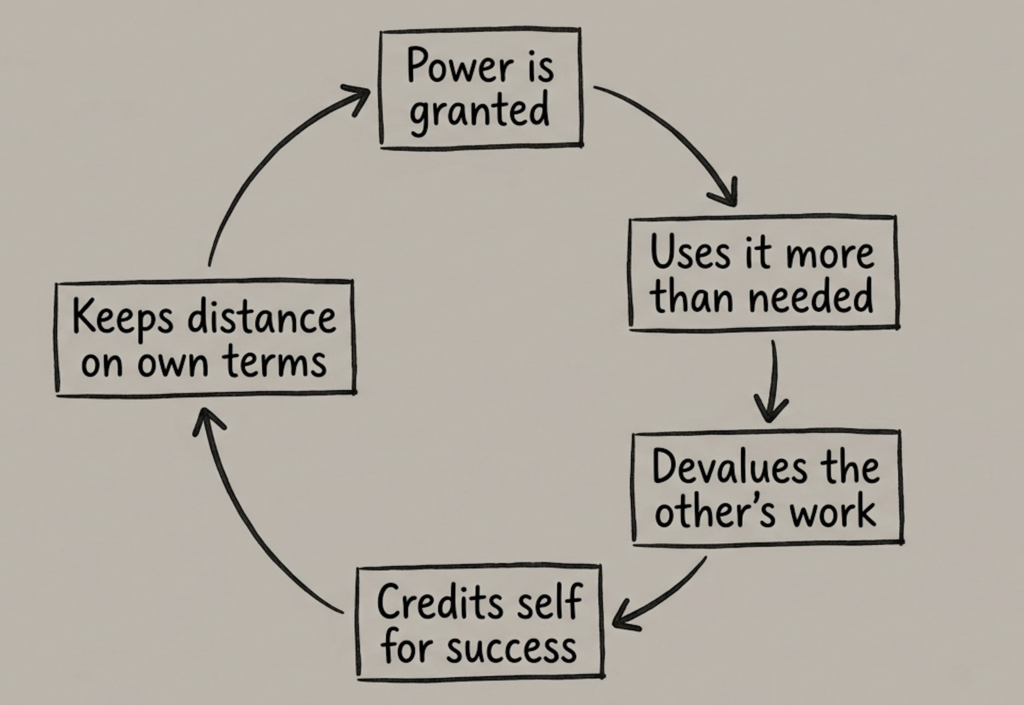
Kipnis’s metamorphic cycle of power, illustrated
“Will this backfire?”
Dacher Keltner, Deborah Gruenfeld and Cameron Anderson took this further in 2003, in what they called approach-inhibition theory. Most people carry a kind of internal brake, a habit of pausing to scan for social risk before acting: will this upset someone, will this backfire, will this cost me something. Power loosens that brake. It doesn’t switch off the scanning entirely, it just makes the scanning feel unnecessary, because there is less risk left to find.
That single loosened brake explains two things that usually turn up together in the powerful: the confidence, and the carelessness. Both are the same mechanism, seen from different angles.
A more recent complication, from Aleksandra Cislak and colleagues in 2018, sharpened the picture further. It isn’t authority in general that corrupts, they found. It’s authority over people specifically. A sense of personal control, without power over anyone else, showed none of Kipnis’s effects. The corrosion lives in the relationship, not in confidence itself.
A 2019 student replication attempt at Saint Mary’s University found something worth sitting with too: modern MBA-style participants were far less willing to use institutional power at all, in either condition, than Kipnis’s 1972 subjects were. That doesn’t erase the original finding. It suggests the willingness to reach for power may itself shift with the times, even while the corrosive effect, once power is used, still shows up.
The pattern since
Boeing’s 737 MAX programme offers the clearest global case. Congressional investigators found a “culture of concealment” in which senior engineers’ safety warnings were repeatedly dismissed by management racing to compete with Airbus, with a documented disconnect between senior leadership and the rest of the organisation. Three hundred and forty-six people died in the two crashes that followed. The mechanism is the one from the lab, at industrial scale: the less powerful were heard less, believed less, and acted on less, the further up the hierarchy their concerns had to travel.
Australia’s Crown Resorts spent years operating casinos while, according to three separate government inquiries, facilitating money laundering that its own bankers had flagged, and continuing regardless. Executives close to major shareholder James Packer dismissed regulatory concern as noise rather than signal, the exact devaluation Kipnis measured in a lab: subordinate information discounted, once the people delivering it are seen as beneath serious engagement. A separate inquiry into Crown’s Perth casino reached the same conclusion about the company’s suitability to hold a gaming licence at all.
What a leader can do with this
None of this means power should be avoided. It means it should be structurally checked, not just personally resisted, because Kipnis’s subjects didn’t set out to devalue anyone. The distortion arrived on its own, as a side effect of the role. Leaders serious about resisting it build in mechanisms that don’t depend on their own vigilance: someone formally tasked with arguing the other side, decision rights genuinely distributed rather than nominally delegated, and regular, structured contact with the people furthest from the decision, not just the ones already in the room.
This is the seventh in a series on research that changed how we understand organisations and the people in them. Each post covers one paper or study, clearly described, and what a working leader might do with it. The work comes from management, organisational behaviour, sociology, and psychology. The selection criterion is simple: it has to have been right about something important, and mostly ignored in the places that needed it. The previous post on The Learning Problem is here.