Share


Part 2 of 5 | Flyntrok Blog Series: When the Tool Changes
The Question Nobody Warned You About
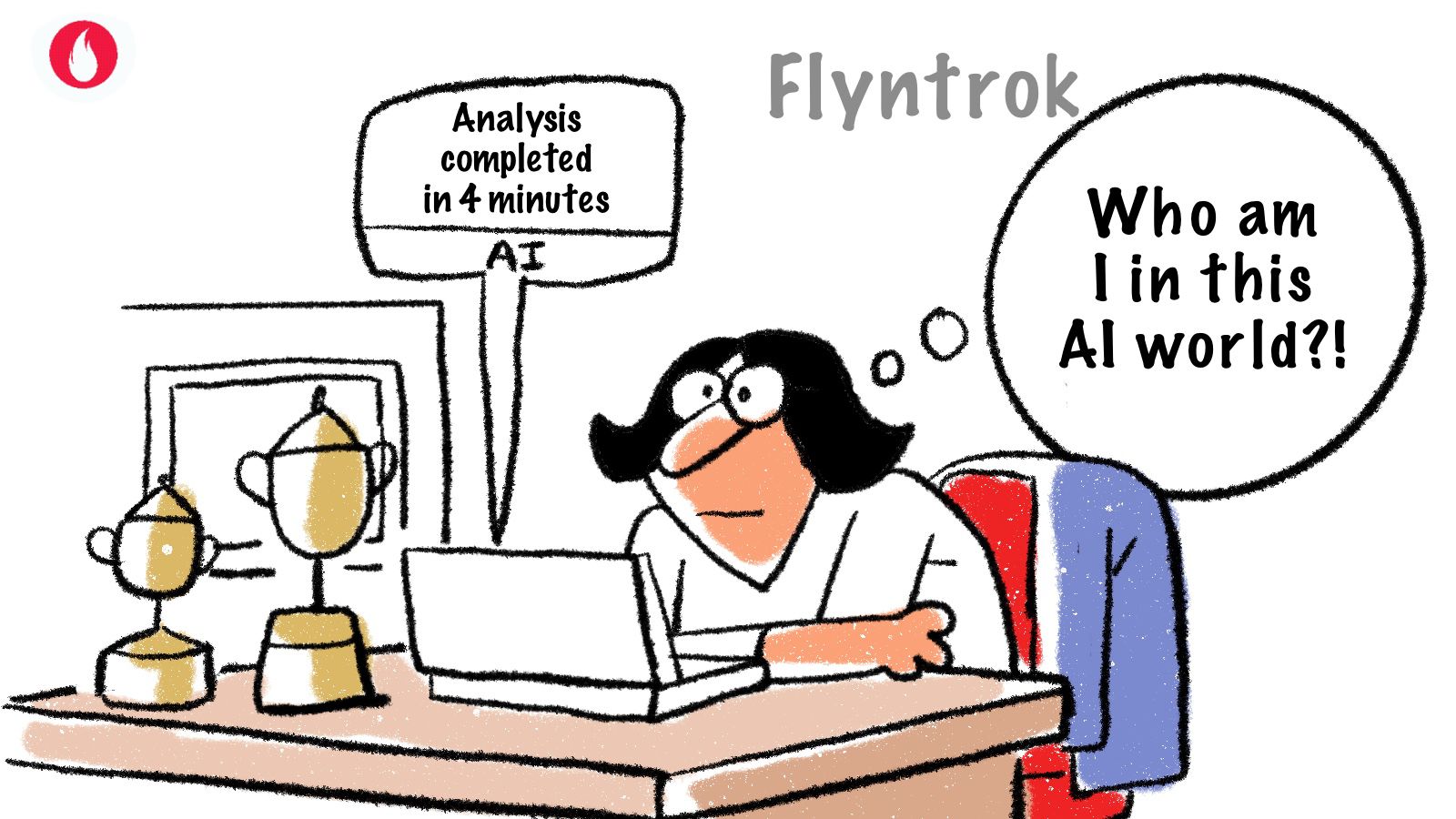
Picture a software engineer who has spent fifteen years defining herself through her code. The elegance of her logic, the efficiency of her solutions, the quiet pride of a clean build. Then, gradually, and then suddenly, AI begins writing the code. Not all of it. But enough of it that she finds herself staring at a screen one afternoon, wondering something she has never wondered before. If I am not the one writing this code, what exactly am I here for?
That question — uncomfortable, disorienting, and surprisingly common right now — is not a productivity problem. It is an identity problem. And the first thing worth saying about it is this. Identity questions are not new. It is not a sign that something has gone wrong with you and us. It is a sign that something very human is being surfaced by a very powerful technology.
A Century of Thinkers Who Saw This Coming
For over a century, some of the sharpest minds in psychology and sociology have been circling the same insight. Identity is not a fixed thing we are born with and carry through life unchanged. It is something we construct, perform, and rebuild — largely through what we do, who we do it with, and how the world responds to us.
William James said it first, in 1890, when he argued that we have multiple selves depending on our context. George Herbert Mead built on it, showing that the self is an ongoing internal dialogue between our impulses and the social world around us. Erving Goffman made it vivid. He described professional life as a performance. With a front stage identity we present to the world and a back stage self that exists underneath it.
Erik Erikson gave us the language for the moment the performance is disrupted: “identity crisis”. Not a pathological problem but a necessary passage that opens when the old story no longer holds.
What all of them were pointing to, in their different ways, is the same thing: we construct our sense of professional self through our tasks. Which means when the tasks change, the identity question opens up whether we are ready for it or not.
The Confusion Between Means and Ends
Here is the deeper problem. Most of us, without ever consciously deciding to, have confused the means for the end. The software engineer was never really the person who writes code. She was always the person who solves complex problems. She translates human needs into functional systems, and makes something work that did not work before. The code was infrastructure. It was the means.
The judgment, the problem framing, the ability to ask the right question of a system — that was always the point. But because the task and the role were never separated, the task became the identity. And now that AI is absorbing the task, it feels like the identity is being absorbed too.
It is not. But our identity does need to be redrawn and recrafted in the AI era.
You Cannot Think Your Way Into a New Identity — You Have to Act
This is where Herminia Ibarra’s work becomes essential. Ibarra, one of the most important thinkers on professional identity and career transitions, argues that you cannot think your way into a new professional identity. Introspection alone will not get you there.
You have to act your way into it. Try things, take on new kinds of work, experiment with a different version of yourself in practice. And let the new identity form through doing rather than through reflection alone.
This is not always easy, alebit very important. Redrawing the arc of your professional identity is not a weekend exercise or a line in a performance review. It deserves honesty, deliberate effort, and in many cases, support. The disorientation is real. The grief for the old version of the role is real. None of that should be minimised. We revisit this recrafting in greater nuance in post 6 of this series.
This Is Not Just a Personal Question — It Is An Organisational One
In our work, we see professionals across industries and geographies, struggling with this. Sometimes it is a question being asked across entire teams and functions. And most organisations are not designed for it. Job descriptions are still written around task clusters that AI is dissolving. Performance frameworks still reward the execution of things that will soon be automated. Hiring decisions are still anchored in technical skills whose half-life is shrinking by the month.
Organisations, like the individuals within them, have built their identity around what they deliver and how they deliver it. When AI begins to absorb that delivery, the identity question does not stay with the individual. It moves to the team, the function, and eventually the organisation itself.
The organisations that will navigate this well are not necessarily the ones moving fastest on AI adoption. They are the ones creating deliberate space for their people to ask the identity question. To examine what their roles are actually for, to separate the task from the purpose it was always meant to serve. And to redesign around that purpose rather than around the task.
Slowing Down To Meet the Change
The technology is moving faster than the conversation about what it means. This post is an attempt to slow that down for a moment — not to resist the change, but to meet it with the clarity it deserves. The next post explores one of the most concrete expressions of that shift — the movement from execution to insight — and why it is an identity question as much as a leadership one.
Further Reading and References
The ideas in this post draw on over a century of thinking about identity, work, and what it means to be a professional in transition. If any of these threads resonated with you, here is where to go deeper.
The foundational thinkers
William James — Principles of Psychology (1890). The original argument that we have multiple selves, shaped by context and social interaction. The starting point for almost everything that followed. Stanford Encyclopedia of Philosophy — William James
George Herbert Mead — Mind, Self, and Society (1934). The idea that identity is an ongoing internal dialogue — between who we are and how the world responds to us. Internet Archive — Mind, Self, and Society
Erving Goffman — The Presentation of Self in Everyday Life (1959). The front stage and back stage of professional identity — and the gap between the performance and the person underneath it. Wikipedia overview | Goodreads
Erik Erikson — Identity: Youth and Crisis (1968). The concept of identity crisis as a necessary passage rather than a pathology — and what happens when the old story no longer holds. Overview via Stanford Encyclopedia
Herminia Ibarra — Working Identity: Unconventional Strategies for Reinventing Your Career (2003, updated 2023). The most practical and important book on professional identity transitions — and the argument that you cannot think your way into a new identity, only act your way into it. Ibarra’s website | Harvard Business Review Press
Additional Research
Caza, B. et al. — Identity Work in Organizations and Occupations (2018). A comprehensive review of how professionals construct, maintain, and revise their identities through their work. Full paper — University of North Carolina Greensboro
Stickney Research — You Are Not Your Job (2025). A readable synthesis of research on the psychological risks of over-identifying with professional titles and tasks. Full article
Psychology Today — The Dangers of Over-Identifying With Your Job (February 2026). Drawing on the Global Flourishing Study of over 200,000 adults across 22 countries, this piece makes the case for building identity beyond occupation. Full article
Lepitso A.D et al. – Western Michigan University – Identity Work within and beyond the Professions: Toward a Theoretical Integration and Extension. Chapter link.