Share



Management research has a strange relationship with practice. The best of it arrives, gets cited in conference decks, and then changes very little. The insight sits in the literature. The organisation carries on.
This series is an attempt to close that gap, modestly. Each post covers one piece of foundational research, explains what it actually says, and considers what a working manager or senior leader might do with it. No frameworks dressed up as solutions. No promises the evidence does not support.
Just the work, clearly described, and what follows from it.
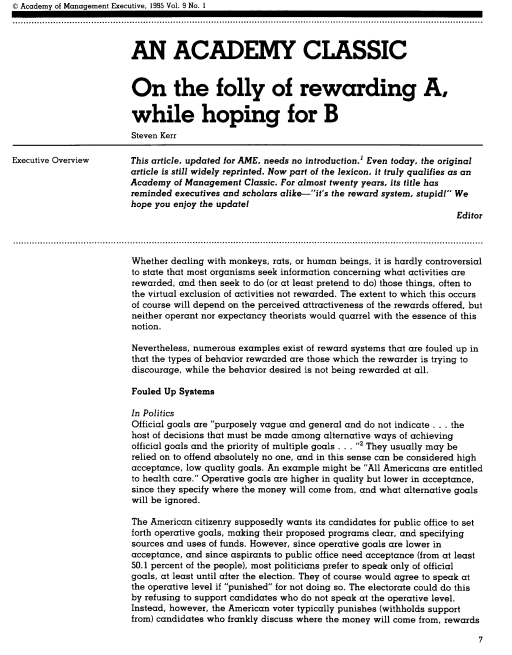
In 1975, a management academic named Steven Kerr published a paper so obvious in its central observation that you wonder why it needed writing at all. Organisations, he pointed out, routinely reward one set of behaviours while hoping people will produce a completely different set. They then express surprise when people produce the behaviours they rewarded.
The paper became one of the most cited in management history. Which tells you something about how long it takes for obvious things to travel.
What the paper actually says
The core argument fits in a sentence. Reward systems almost always measure what is easy to measure, not what actually matters. Over time, people respond to what gets measured. The gap opens up quietly, and then becomes very wide.
Kerr gave examples that still sting.
A hospital wants doctors to take time with patients, build relationships, exercise careful judgement. It measures throughput, billing codes, and patient volume. Doctors, being rational, optimise for throughput. Nobody is being cynical. They are reading the actual system accurately.
A university wants professors to teach well. It rewards publications. The better teachers who are indifferent researchers get passed over. Again, not cynicism. Just rational response.
A company wants long-term thinking from its senior leaders. It pays bonuses on quarterly results. Leaders focus on this quarter. The board then wonders why no one is building for the future.
The pattern repeats across every sector Kerr examined. The institution’s stated goal and its actual incentive structure point in different directions. People go where the incentives point.
Why it keeps happening
Three things drive this, and they are worth naming plainly.
The first is measurement. Long-term health, psychological safety, creative risk-taking, trust built over years — these are genuinely difficult to count. Lines of code, calls handled, quarterly revenue — these are easy. Easy wins. The measurable becomes the target, and the important becomes invisible.
The second is time. The behaviours that produce the best long-term outcomes tend to produce results slowly. Cutting corners pays off next quarter. Building something properly pays off in three years, and by then the person who built it has moved on and the connection is invisible anyway. Incentive systems discount the future structurally, not maliciously.
The third is attribution. Even when a good outcome eventually arrives, it is nearly impossible to trace it to a specific decision made years earlier. The manager who built a culture of honest feedback that prevented a catastrophic error in year four gets no credit. The credit has no address. So it goes unclaimed, and the behaviour goes unrewarded.
What this means if you are running something
The first thing it means is that your stated values are almost certainly not your operating values. The operating values are visible in what actually gets rewarded, promoted, recognised, and tolerated. If these differ from what is written on the wall, people knew before you did.
The second thing it means is that appeals to culture, purpose, and shared values have limited traction until the incentive structure is aligned with them. Structure shapes behaviour more reliably than rhetoric does.
The third, and perhaps the most practically useful: before you redesign your reward system, audit it honestly. For each behaviour you say you want, ask where in this system that behaviour actually gets rewarded. If the answer is nowhere clear, you have found your problem. A design problem. Not a people problem.
Kerr was writing in 1975. The paper is freely available. It takes about forty minutes to read.
The fact that the pattern he identified remains the dominant condition in most organisations is either a tribute to how hard the problem is, or a rather precise demonstration of his thesis.
Probably both.
This is the first in a series on research that changed how we understand organisations and the people in them. Each post covers one paper or study, clearly described, and what a working leader might do with it. The work comes from management, organisational behaviour, sociology, and psychology. The selection criterion is simple: it has to have been right about something important, and mostly ignored in the places that needed it.