Share


Ray Kurzweil, the futurist who predicted the rise of the internet, the smartphone, and AI’s dominance decades before they arrived, has long spoken of a Singularity — a point in the future where AI would equal and then surpass human intelligence. Not through a dramatic event, but through a self improving loop of AI. He predicted this would happen by 2045.
Today we are seeing clear signs of the feedback loops which are helping AI get better faster. Remember the first version of GPT we used in 2023-24, it was exciting but was not very useful. It seems like a pale comparison of the AI models and agents we use today. AI has moved away from needing constant prompting to be able to run commands and make decisions independently.
As individuals and teams get better with AI – what about organisations? What happens to organisations that manage to adopt AI differently? How much smarter do these organisations become? What if there was a self improvement loop for organisations too, driven by AI.
What if there was a possibility of an Organisational Singularity?
What Is Organisational Singularity?
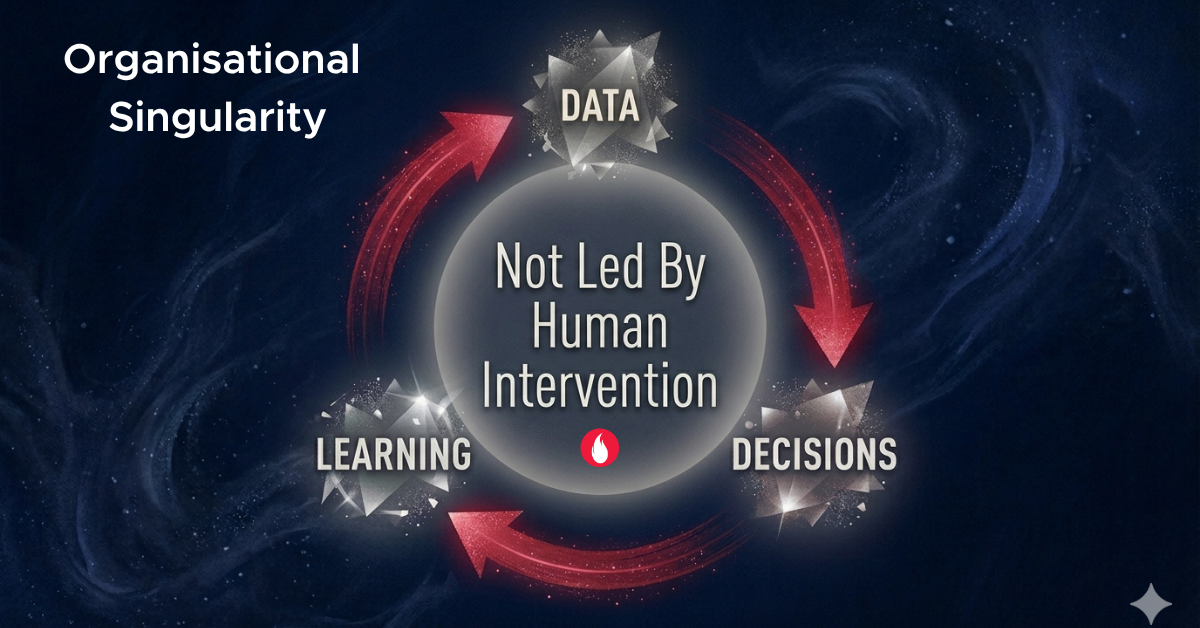
Organisational Singularity is the point where data —>decisions —> and learning connect in a continuous loop that improves itself over time, with or without anyone consciously directing it. It arrives for organisations when AI stops being something employees use as merely a tool and starts being something the organisation thinks with. Not a system that replaces human judgment. A system that makes the organisation’s collective judgment sharper, faster, and self-reinforcing.
This is different from what Kurzweil described. He was talking about machines surpassing individual human intelligence. Organisational Singularity is — the moment an organisation stops depending only on humans to connect the dots, transfer the knowledge and starts doing it by itself.
Here is a comparison and an example:
Any organisation today is smarter than any ‘single’ individual within them. A hospital knows more than any one doctor. A bank knows more than any one analyst. But organisations today are dependent on people showing up, communicating effectively and transferring knowledge. It is fragile and slower. It learns through meetings, reports and decisions made by humans.
Consider a hospital in the future, where patient intake data feeds a diagnostic AI. This surfaces patterns that improve treatment protocols, which generate better outcome data. Which then trains the diagnostic model further. Individual clinicians and doctors are not replaced — in fact their expertise becomes sharper because the system surfaces what experience alone would take years to accumulate. But crucially, the organisation is now learning between decisions, not just because of them. The institution itself is getting smarter — continuously, without a meeting being called or a strategy being announced.
This is Organisational Singularity in action. And what makes it singular is this: the loop doesn’t stop. It compounds.
Why is organisational singularity becoming possible now?
The main reason why organisational singularity is becoming possible – is the shift from intelligence scarcity to abundance.
For over a century, organisations were designed around the constraint that intelligence was scarce and information was expensive. Hierarchy in companies solved this by centralizing knowledge on a need to know basis. Ronald Coase won a Nobel prize for articulating this in 1937 in his paper ‘The Nature Of The Firm’.
Today digital infrastructure and AI have collapsed external transaction costs and the marginal cost of intelligence. In many cases, it is now getting more expensive and slower to perform a task through a corporate hierarchy than to use AI or external digital networks.
The organisational singularity occurs when firms redesign themselves around intelligence abundance. Humans are not replaced in these firms but they lower internal friction and focus on possibilities and speed rather than merely control.
Principles of Organisational Singularity
Three principles help in understanding Organisational Singularity better.
The Compounding Principle
Humans have always been good at visualising and seeing improvements right in front of them. Think of a weight loss or fitness program you have been on. The first two weeks of exercise feels brutal with no visible return. Maybe by month two you start noticing change and it is month six when people start noticing! By then most of us have given up, because we cannot visualise the changes. Nothing dramatic happened in any single week. The body just kept compounding quietly – and the results became visible much later.
AI Singularity is following this exact pattern. Generative AI in 2018 looked interesting but modest. By 2023 it had made a splash and acquired millions of users. By 2025 it was rewriting entire industries. Nobody saw the magnitude coming — not because the signals weren’t there, but because our brains discount exponential curves.
Organisational Singularity works the same way. The organisations quietly building self-improving feedback loops today don’t look dramatically different from the outside yet. Their annual reports look similar. Their headcounts are comparable. But underneath, something is compounding — better data feeding sharper AI, sharper AI producing better decisions, better decisions generating richer data. Round and round, tightening with each cycle.
The compounding happens below the surface before it shows up in results. By the time it’s visible, the gap is already very difficult to close.
The Systems Principle
“The shift is not from people to AI. It is from AI as a tool to AI as connective tissue”.
Most organisations today use AI the way earlier generations used early computers — as a faster way to do existing things. Drafting faster. Analysing faster. Searching faster. The underlying operating model remains the same. Humans still make the calls. Processes still run in silos. Institutional knowledge still lives in people’s heads and disconnected systems.
Organisational Singularity describes a different configuration entirely. One where AI becomes the connective tissue of the organisation — linking departments, decisions, data, and learning in real time. Where insight generated in one corner of the business automatically informs another. Where the organisation doesn’t just store knowledge, it applies it continuously.
This is the operating system shift — and it’s why two organisations with the same AI tools can be on completely different trajectories.
Evolution (Not Extinction Principle)
“The question is not whether people will be replaced. It’s what people will become.”
The most persistent anxiety around AI — at the individual level and now at the organisational level — is replacement. If the system learns and improves by itself, where does that leave the people inside it?
Ray Kurzweil’s answer at the individual level was always the same: humans don’t disappear, they evolve. The relationship between human intelligence and machine intelligence becomes collaborative and over time deeply intertwined.
The same logic applies inside organisations. Look at history to see the pattern below:
Before electricity, factory managers managed physical muscle — the effort and output of human bodies. After electrification, they managed machines and processes. The role didn’t disappear. The nature of it transformed entirely.
At Organisational Singularity, the transformation is similar. Leaders and managers don’t get displaced by the learning system — they move up a level. They shift from managing processes to managing the intelligence layer itself. Setting values and direction. Making judgment calls that require context, ethics, and humanity that AI cannot supply.
“Leaders in the AI era will shift from managing processes to managing and the intelligence layer itself and orchestrating the changes”
Organisational Singularity is Underway Already
Organisational Singularity is not inevitable. Not every organisation will cross this threshold, and crossing it is neither automatic nor guaranteed to be easy.
But for the organisations quietly building these systems right now — connecting their data, closing their feedback loops, rewiring their operating models — something is already underway. The compounding has begun. And like all exponential processes, it will look modest right up until the moment it looks remarkable.
Organisational Singularity has possible already begun its improvement loops. Through small experiments, through learning, through lobsters*!
*The lobsters are real. And they are already learning (Lobster)
Further Reading & References:
The idea that started it all
Ray Kurzweil first laid out his vision of the Singularity in The Singularity Is Near (2005) and updated it three decades later in The Singularity Is Nearer (2024). Both are worth reading if you want to understand where the concept of self-improving intelligence began.
Why organisations exist in the first place
Ronald Coase asked a deceptively simple question in his 1937 paper The Nature of the Firm — why do companies exist at all? His answer: because hierarchy reduces the cost of getting things done together. This thinking won him the Nobel Prize in Economics in 1991 and is the foundation for our argument about intelligence scarcity giving way to intelligence abundance.
Where AI adoption actually stands today
McKinsey’s 2024 report Gen AI’s Next Inflection Point offers the clearest current picture of how far most organisations still have to go — and what separates those moving fastest.
The closest cousin to this idea
Henry Farrell’s The Management Singularity (2024) argues that AI’s most profound impact won’t be on individuals but on the unglamorous machinery of how organisations actually run. A recommended read alongside this piece (Link)
On AI’s rapid progression
OpenAI’s GPT-4 Technical Report (2023) documents the leap that made the feedback loop visible to everyone. If you used GPT in early 2023 and again in 2025 — you’ve already felt the compounding in action.
And finally — the lobsters
The open claw revolution is real and cannot not be ignored. The lobsters are here and they are already learning (Link 1 – Lobster Singularity, Link 2 – Lobster that broke the internet , Link 3 – Lobster farming in China)