Share


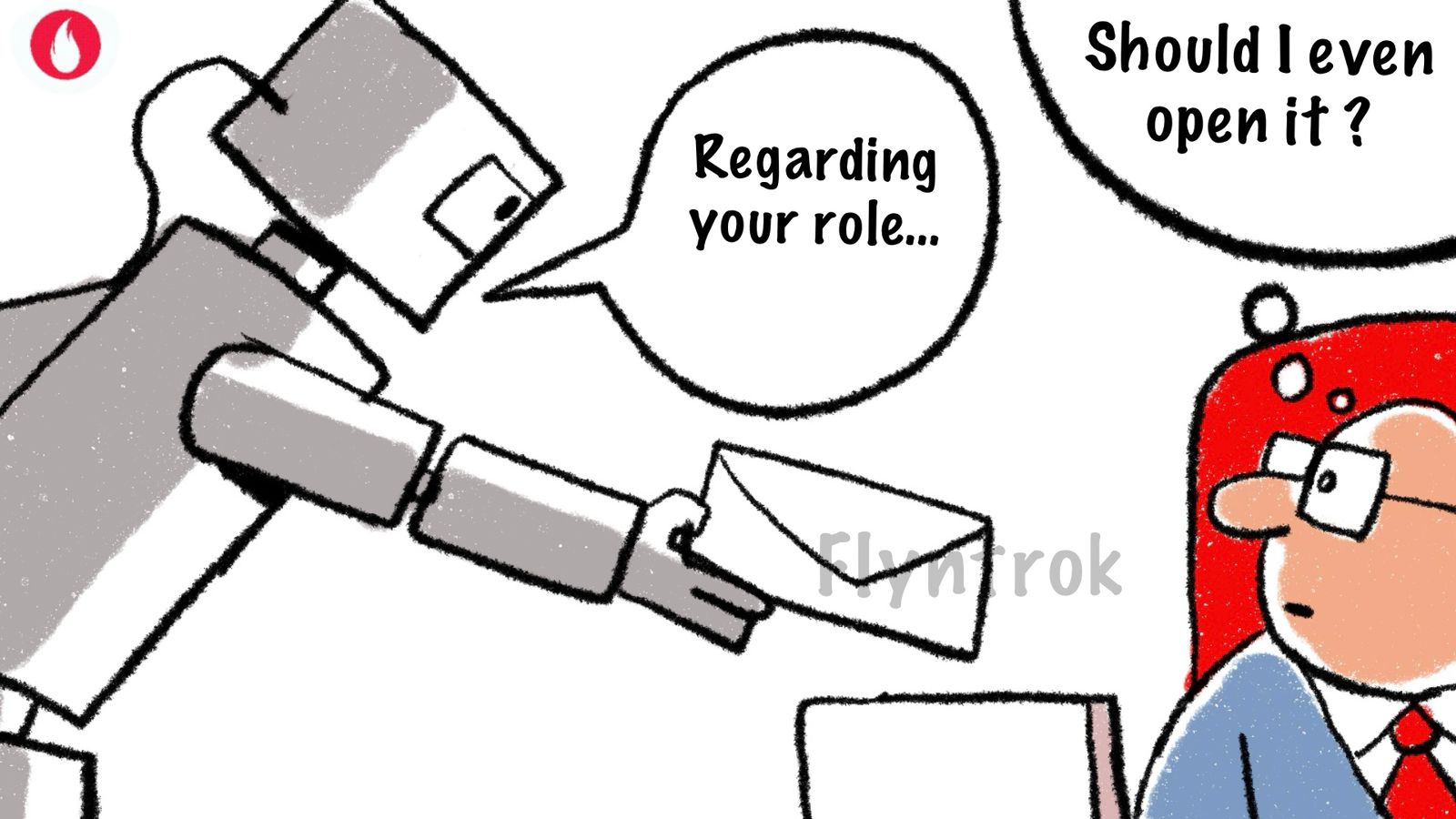
I was talking to my financial advisor recently and he said something that stayed with me. Every industry is being affected by AI, he said. Usually change comes for some sectors at a time. This feels different. It is hitting every industry, every level, every role — the new hire and the CEO alike.
He is right. And what makes it different is not just the wide impact of the change. It is jolting us out of things we assumed were inherently human. We never imagined that a technology or tool we invented could take away so much of what we do! And do it faster, better and cheaper by a significant margin.
Every technology before this changed what we do. The excel replaced the paper ledger. Email replaced the type written memo. Each wave automated a task, and sped something up. Yet we remained untouched in some ways. We had to adapt, learn the new tool, and carried on. While we updated our habits. We rarely had to update our sense of who we are.
Generative AI is asking something harder. It is not just changing what we do. It is asking us who we are in a world where it can do so much of what we did.
That is a very different question. A harder one.
Why does AI feel different?
So why is this moment different? Why is generative AI making us question our roles, our sense of who we are? Our identities?
One, AI speaks your language.
Every tool before this required humans to learn its logic. We learnt formulas to use excel. We learnt software languages to code. To use generative AI, we do not need to learn any new things. We bring our natural language, our context, our intent, and AI meets us there.
Strangely and almost counter-intuitively, when we do not have to learn any specific skill to use a technology, a different question opens up. What am I actually bringing to the table? Just like the London cab drivers when GPS arrived. Suddenly the thing that defined them was available to everyone. Ease made their edge invisible.
This question is not a capability question. It is an identity one.
Two, Speed of AI Creation
Think about a piece of work that used to take you two days. A report. A proposal. A first draft of something complex. Generative AI can produce a version of that in four minutes. This is not an incremental improvement. It is an entirely different league and the difference is hard to ignore.
When speed and output is no longer our advantage, the question shifts. What do I contribute to the outcome is the question staring at us. And this is not a productivity question. It is a personal one.
Three, It removes the skill excuse.
With earlier technologies, not knowing how to do something was a legitimate boundary. “I am not a designer” or “I am not a data analyst” were reasonable things to say. Those boundaries gave us clarity about what our role was and was not.
Generative AI quietly removes that defence. You do not need to be a designer to create a visual. You do not need to be an analyst to analyse data. When the technical barrier falls away, a different and more uncomfortable question takes its place. Not what can I do — but what is it that only I can bring?
The Real Question
AI touches how we see ourselves. It forces us to ask the question: What is it that only I can bring?
Not what can I do faster with AI. Not what tasks can I offload. But what is the thing — the judgment, the instinct, the human quality — that I bring to this work that the technology cannot replicate.
This question is an identity question. An identity question is not about what you can do. It is about who you are when the doing is taken care of. Most of us have never had to answer that at work before. And it does not have a quick answer.
In the last post we asked three questions to help start that process — what to let go, what to add, and what to protect. But identity recrafting goes deeper than three questions. Over the next few posts, we will explore what that deeper work actually looks like — and what it asks of us.