Share


The previous post on AI in particular and technology in general, forcing humans to adopt new identities got us a few interesting conversations. One of the leaders said “Factories and the printing press were threats right from the start. They were always going to replace humans and hence it was apparent that we had to step up differently. But AI is an enabler, a technology which is helping humans do better. Why would we need new identities in such a situation?”.
The need for change is easier to see when there is a threat. We have seen this time and again in our work. Individuals and organisations that have their back against a wall rally differently. When revenues are threatened, when survival is at stake, new ways of working and new identities are easier to adopt. More often than not however, the need for change is strongest when things seem to be going well.
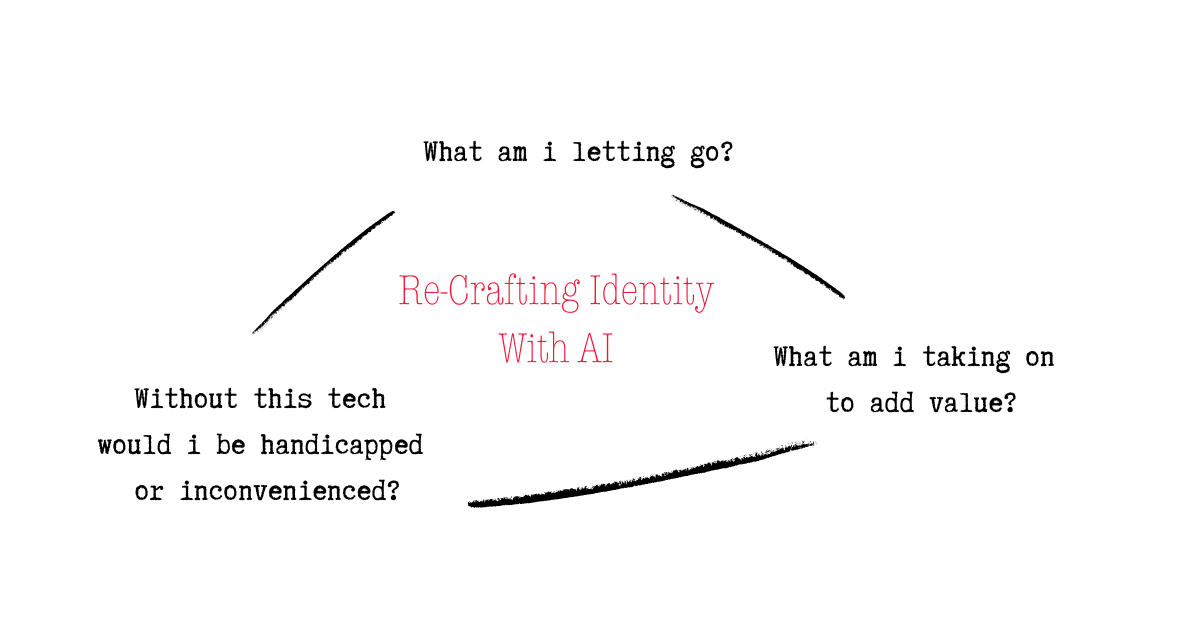
Take a radiologist for example. Technology currently helps assess scans far better. AI identifies anomalies more accurately. On the face of it, things are going well. Work gets done faster and more accurately. This is usually when professionals surrender control to technology and at best do more of the same. It is at this precise moment when professionals across industries should be asking three questions. These are not just questions about your work. They are questions about who you are becoming in your role. Answering them consciously is how identity recrafting happens. In the small deliberate choices you make about what to hold and what to release.

What am I letting go?
What am I taking on that will add value?
If this technology disappeared tomorrow, would I be inconvenienced or handicapped?
These three questions are not a one-time exercise. The tools will keep improving. Roles and identities will keep shifting in response. The professionals who do well are not the ones waiting for a crisis to force their hand. They are the ones asking these questions now, while everything still feels fine.
Recrafting your identity is not a crisis response. It is an ongoing practice.
And it can start with three questions.
Further Reading
A flight Simulator Study. Impact of automation level on airline pilots’ flying performance and visual scanning strategies. https://www.sciencedirect.com/science/article/pii/S0003687024002333
Use It Or Lose it. Without practice, pilots find that some flying skills — especially cognitive skills — grow weak. https://flightsafety.org/asw-article/use-it-or-lose-it/
On radiologists actively recrafting their identity in response to AI