Share


Psychometrics has always promised the same thing: that the messy, contradictory, context-dependent business of being human can be captured in a number. For decades, that promise has been worth billions. In 2023, the global psychometrics market was valued at $2.4 billion. By 2031, it is projected to reach $5.9 billion.
A lot of that money is chasing certainty in a domain that resists it.
I have worked with personality tools for most of my professional life. The one I return to most often is the Big Five. Not because it tells me who someone is. Because it opens a conversation about who they might be. That distinction matters more than most practitioners acknowledge.
Now AI is entering the field, and the gap between measurement and meaning is widening.
What the research showed
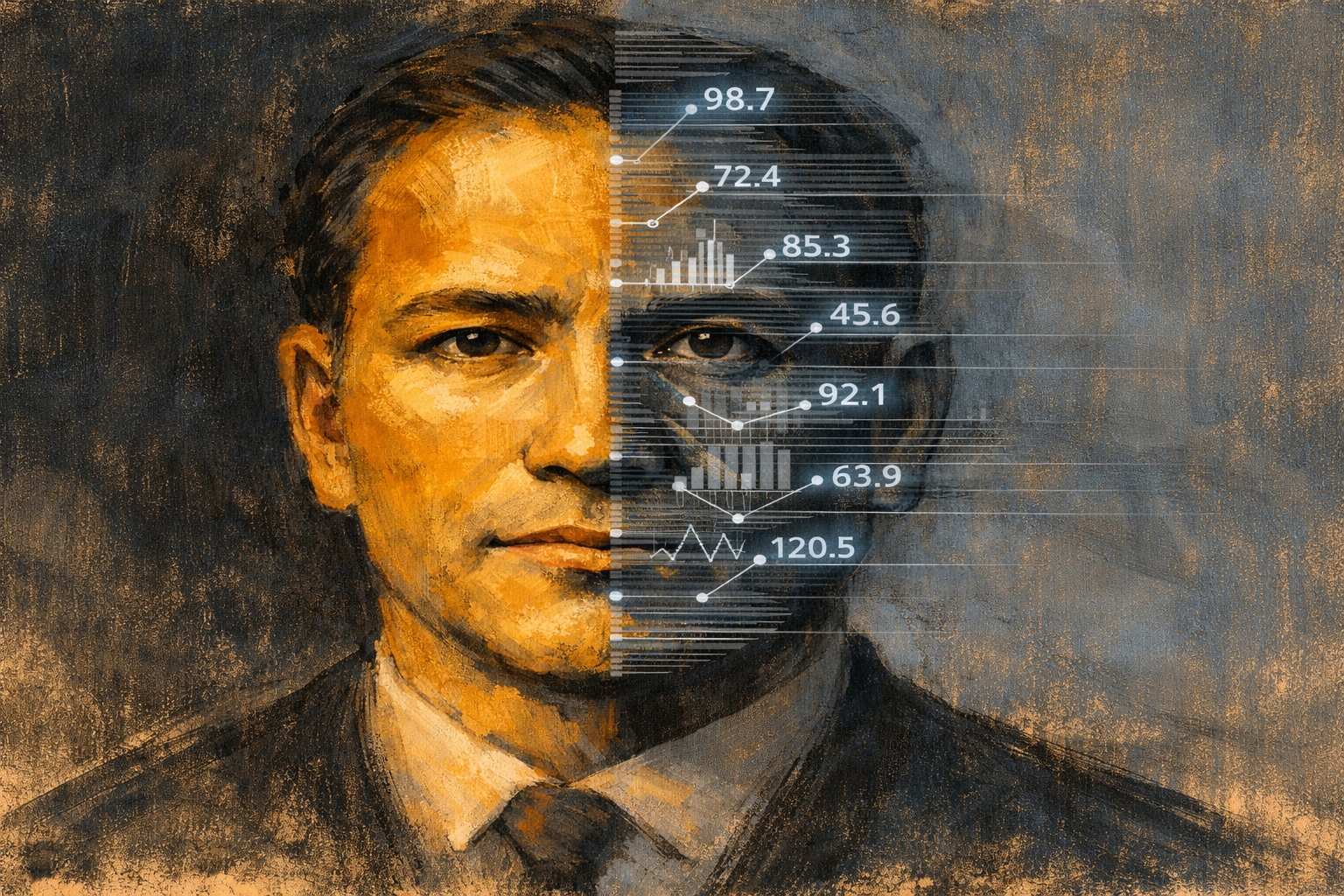
A study published in early 2025 by Marius Guenzel, Shimon Kogan, Marina Niessner, and Kelly Shue analysed 96,000 MBA graduates and their LinkedIn photographs. Using machine learning to extract Big Five personality traits from facial images alone, the researchers produced what they call the “Photo Big 5.”
The findings were striking. The AI-inferred personality scores had weak correlation with academic performance. But they were strong predictors of real-world outcomes: earnings, seniority, career mobility. The pay gap between people at the top and bottom of the AI’s personality rankings was larger than the Black-White salary gap for men in the same dataset.
The researchers were careful to frame this as a capability, not a recommendation. I think they were right to be careful.
The tool I actually use
The Big Five measures five dimensions of personality: openness, conscientiousness, extraversion, agreeableness, and neuroticism. Unlike the MBTI, which places people into fixed types, the Big Five is statistically robust and treats personality as a spectrum. It has been validated across cultures and decades of research, with the term “Big Five” coined by Lewis Goldberg in 1981 and the framework refined by McCrae and Costa through the 1990s.
But its value, in my experience, is not in the scores themselves. It is in what happens when someone sits with their results and starts to question them. Is this who I am, or who I have had to become? Does this reflect my nature or my circumstances? Which of these traits has served me, and which has cost me?
Those questions cannot be generated by a measurement. They require a conversation. The measurement is just the prompt.
What AI changes
The Photo Big 5 is a different kind of tool. It does not ask you anything. It observes, infers, and concludes. There is no space in the methodology for context, for history, for the person to push back. The score arrives without a question attached to it.
This is not a flaw in the AI. It is doing what AI does well. It finds patterns in data at a scale no human analyst could match. The problem is that we are applying a pattern-recognition capability to a domain where the pattern was never really the point.
Personality is not a fixed property to be detected. It is shaped by experience, by relationships, by failure, by conscious effort. Every leader I have worked with has a story about how they changed. A role that stretched them. A crisis that reordered their priorities. A piece of feedback that shifted something permanently.
A model trained on photographs cannot capture any of that. It captures a moment, in a specific light, on a specific day, filtered through whatever expression someone chose for their professional headshot.
The bias hiding inside the objectivity
There is a subtler problem too. AI models learn from historical data. The Photo Big 5’s predictive power comes from patterns in what has led to success in the past. But past success in any field reflects the preferences of the organisations and cultures that defined it. If certain personality presentations were historically rewarded, the model will encode that preference as though it were a law of nature.
We will not have reduced subjectivity. We will have automated it, scaled it, and dressed it in the language of data science.
The MBTI has been widely criticised for lacking scientific grounding, yet it persists because it gives people a simple, memorable label for something that feels real. The Photo Big 5 has stronger predictive validity and no labels at all. Just a score, quietly shaping outcomes before anyone has spoken. One of the study’s co-authorsnoted she worries this could be used in ways that “make a lot of people unhappy.” That is a significant admission from someone whose work may accelerate its adoption.
The question worth asking
The psychometrics industry is large because organisations genuinely want to understand people better. That is a reasonable desire. The Big Five, used well, serves it. So do other rigorous tools, applied with care and followed by dialogue.
AI will make measurement faster, cheaper, and more scalable. It will surface patterns that human assessors miss. Some of that will be genuinely useful.
But measurement and meaning are not the same thing. A score tells you where someone sits on a dimension today. It does not tell you how they got there, what they are working on, or where they are going. Those are questions a tool cannot answer. They require a person, a conversation, and enough humility to know that the score is the beginning, not the end.
The quiet risk in all of this is not that AI will get psychometrics wrong. It is that AI will get it right, in a narrow sense, and we will stop noticing everything the number leaves out.T
_________________________________________________________________________
Do check out this piece on ‘conversational debt’. It speaks to what we have here.