Share


There is a growing body of writing about storytelling as a tool for change. It draws on neuroscience. It argues, persuasively, that narrative shapes what people believe is possible and that shifting the story can shift the system. Much of this thinking is genuinely useful — and the underlying claim holds up in social movements, brand campaigns, and public advocacy.
Inside organisations, things are considerably messier. Because organisations are not waiting for their leaders to tell them a story. They are already reading one.
Two Stories Running at Once
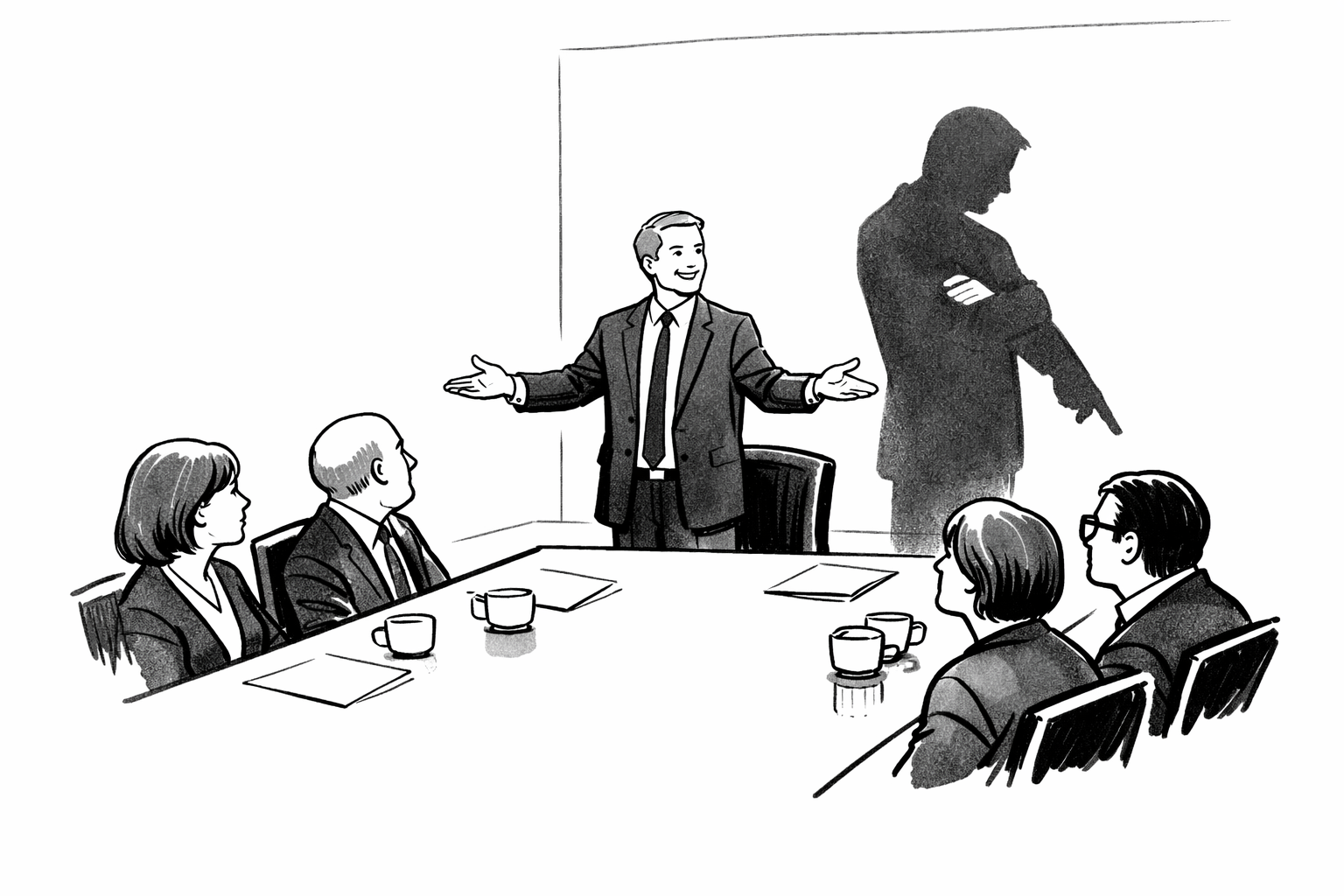
Every organisation runs two narratives simultaneously. There is the declared story — the one in the strategy deck, the values statement, the CEO’s quarterly address. And there is the enacted story — the one that lives in decisions made under pressure, in who gets promoted and why, in what gets tolerated at the top and quietly punished lower down.
People are extraordinarily good at reading the enacted story. They have to be. Their careers depend on understanding where power actually sits, which stated commitments will buckle when they become inconvenient, and what is genuinely rewarded versus what is merely applauded. This is not cynicism. It is sense-making. And it happens whether or not leaders intend to send a signal.
The gap between the two stories is rarely the result of dishonesty. Most leaders believe the story they tell. They are committed to empowerment, to psychological safety, to developing the next generation. The problem is that belief and behaviour operate on different timescales. Belief shifts in the room where the vision gets articulated. Behaviour shifts — if it shifts at all — over months and years of practice, setback, and uncomfortable feedback. In the meantime, the organisation watches. And it draws conclusions.
Why Change Narratives Stall
This is the context in which most change narratives fail — not because the story is wrong, but because it collides with an older, better-established one. A leader speaks of empowerment; the organisation remembers the last three times a decision got reversed from the top. A leadership team declares that challenge is welcome; people recall what happened to the last person who challenged something publicly.
“The difference between what a leader says and what she does is a ‘say-do gap’ that, if allowed to persist, will not only destroy the trust others have in her as a leader but will infect the organisation and begin to damage its brand.”
— Joel Peterson, Chairman of JetBlue Airways; faculty, Stanford GSB
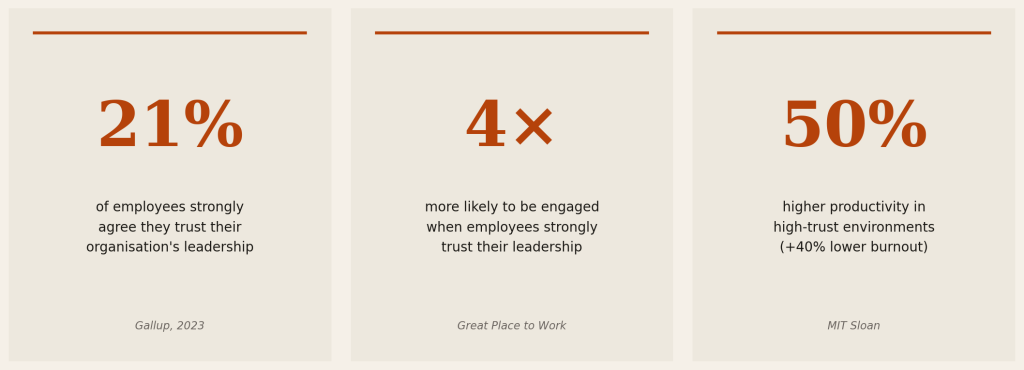
You cannot talk your way out of a pattern that your behaviour maintains. And the more polished and confident the new story, the more it can harden resistance — because sophistication without corresponding action reads, correctly, as spin. Gallup’s research makes the dynamic plain: trust in leadership has been declining since its 2019 peak, and the primary driver is not poor communication. It is the gap between what leaders say and what they visibly do.
The most effective change leaders are not necessarily the most compelling storytellers. They are the ones with a high tolerance for the discomfort of honest diagnosis — who ask, with some regularity, whether the story they are broadcasting through their behaviour is the one they would choose to tell if they were narrating it deliberately.
What a Leader Can Do
- AUDIT THE ENACTED STORY, NOT JUST THE DECLARED ONE
Ask three or four people who will tell you the truth: what story does my behaviour currently tell? What do I signal about priorities through my use of time, my reactions under pressure, the conversations I avoid? This is not a communications exercise. It is a diagnostic one.
- NAME THE GAP PUBLICLY
If there is a distance between the story you have been telling and the one you have been living, say so. Not as self-flagellation, but as orientation. People do not need a perfect leader. They need one who can see clearly and speak plainly. Naming a gap is, itself, an act of the new story.
- CHOOSE ONE VISIBLE BEHAVIOUR TO CHANGE, AND MAKE IT LEGIBLE
Grand narrative shifts are invisible until they produce specific, observable actions. Pick one behaviour that concretely enacts the story you are trying to tell — and do it consistently, in situations where the old pattern would have prevailed. One meeting where you hold back. One decision you push down rather than take. Repeated enough, this becomes the new plot.
- SLOW DOWN THE STORY
The impulse to communicate change is often an impulse to resolve discomfort quickly. Resist the urge to announce before you have acted. Harvard Business School’s research on trust is consistent here: reliability — doing what you said you would do — matters more than the quality of what you said. Under-promise. Over-deliver. Then talk about it
Storytelling matters. It gives people orientation, provides language for collective change, and makes new possibilities feel real. But in organisations, it works only when the narrator is also willing to become a different character. The story you tell is the starting point. The story you live is the proof.