Share


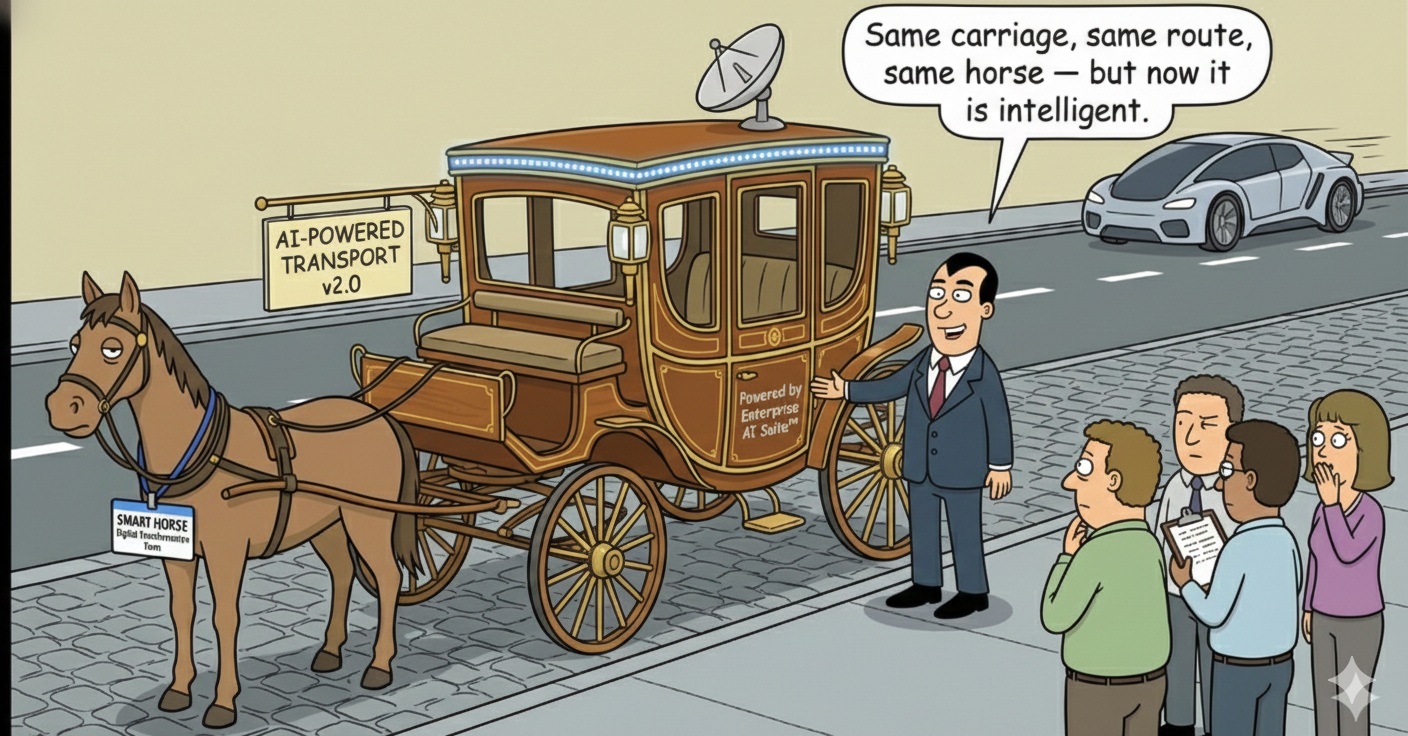
Most organisations are using AI. Very few are using it well. Many organisations deploying AI are stuck in what I call “enhancement mode” —— and the pitfalls that keep them there are remarkably predictable. For instance, using a general-purpose technology to do old things slightly faster. They are automating bad processes instead of reimagining good ones.
And they are leaving transformative value on the table.
To be fair change and transition is not a linear, simple path. It is a journey of experiments, detours and crossroads. Because the difference between organisations that extract real value from AI and those that do not is not the technology they buy. It is the organisational decisions they make — or fail to make — at four critical stages.
The Four Stages of AI Adoption Within Organisations
AI adoption is not a one-time rollout. It’s a cycle that organisations move through repeatedly — every time they tackle a new use case, every time capabilities advance. Think of it as a loop, not a line. And at each turn of this loop, there are four stages where decisions determine whether you stay stuck or break free.
Stage 1: Procurement. Before you deploy a single tool, you make foundational decisions that set everything in motion. How do you position AI internally — as a threat or a strategic capability? Do you start with real problems or chase shiny demos? Do you build internal muscle or outsource your transformation to consultants? Get procurement wrong, and every stage that follows inherits that original mistake.
Stage 2: Deployment. Two decisions determine whether AI spreads virally through your organisation or dies quietly in the pilot phase. Do you treat AI like another software rollout — install it, train people once, measure logins? Or do you recognize that AI requires fundamentally different deployment thinking? And who owns the AI agenda — IT alone, or the people who actually do the work?
Stage 3: Evaluation. You cannot improve what you do not measure. But measuring the wrong things keeps you stuck. Are you tracking adoption metrics that look impressive in a dashboard but tell you nothing about value? And when early results underwhelm — as they inevitably will with any general-purpose technology — do you pull the plug too quickly, or do you have the patience to let transformation unfold?
Stage 4: Growing. AI capabilities do not stand still, and neither can your organisation. Have you redesigned workflows and structures, or just layered AI on top of what already existed? Are you building capacity for tomorrow’s AI, or optimizing only for today’s? And critically, are you thinking about the humans in this equation — the apprenticeship pipelines that are breaking down, the career arcs that need redrawing?
The 11 Pitfalls
Across these four stages, we have identified 11 specific pitfalls — predictable traps that organisations fall into, often with the best of intentions.
Here is the map:
- Pitfall 1: Positioning AI as a Threat
- Pitfall 2: Buying Tools Before Defining the Problem
- Pitfall 3: Outsourcing Transformation Instead of Building Internal Muscle
- Pitfall 4: Treating AI Like a Plug-and-Play Software Rollout
- Pitfall 5: Banning, Centralising, or Outsourcing AI to IT
- Pitfall 6: Sticking with Existing Metrics
- Pitfall 7: Giving Up Too Quickly
- Pitfall 8: Not Redesigning Workflows and Structures
- Pitfall 9: Not Building Capacity for Tomorrow
- Pitfall 10: Broken Apprenticeship Systems and Talent Pipelines
- Pitfall 11: Not Helping People Redraw Their Arc
Why This Matters Now
There is a pattern worth noting: these pitfalls compound. Position AI as a threat (Pitfall 1), and you guarantee resistance during deployment (Pitfalls 4 and 5). Measure the wrong things (Pitfall 6), and you will almost certainly give up too quickly (Pitfall 7). Skip workflow redesign (Pitfall 8), and no amount of investment in talent pipelines (Pitfall 10) will save you. The risks of AI are many.
What’s Next
Over the next several posts, we will unpack each of these 11 pitfalls in detail. Each post will include the core insight, a real-world narrative of what goes wrong, a counter-example of what going right looks like, and practical guidance for breaking free.
We start first with the pitfall that poisons everything downstream: what happens when your organisation — deliberately or by default — positions AI as a threat to the people who are supposed to use it.
This is the first in a series of 12 posts exploring the organisational pitfalls of AI adoption. Next up: Pitfall #1 — Positioning AI as a Threat.