Share


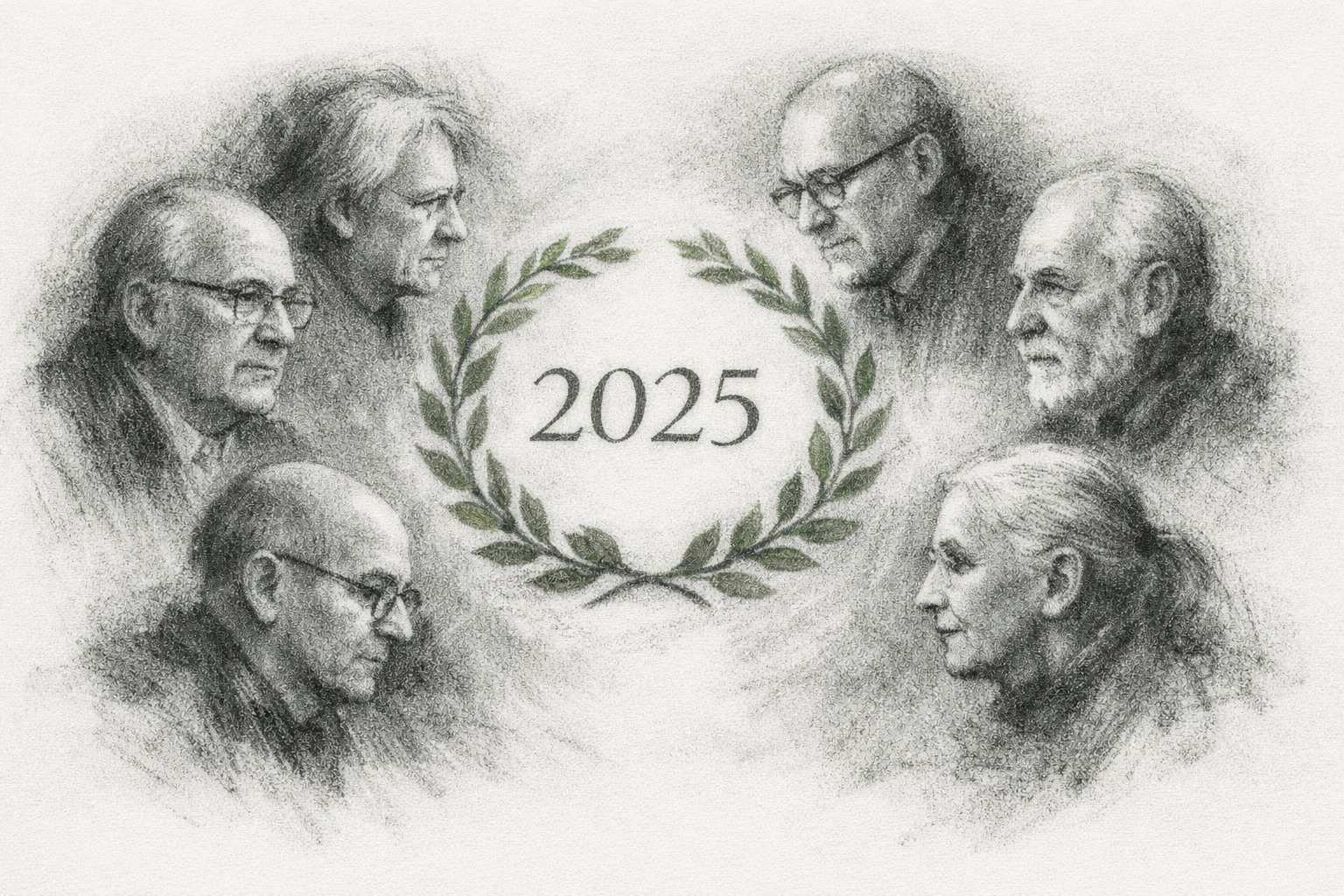
2025 marks the quiet thinning of a post-war Western intellectual generation that learned early to distrust certainty. Shaped by war, ideology, reconstruction, and institutional rebuilding, these thinkers understood what happens when moral confidence runs ahead of moral reflection. They worked slowly. They resisted neat answers. They treated ideas with care, knowing that ideas shape systems, and systems shape lives.
They were united by temperament. Sceptical of speed. Wary of abstraction. Alert to the ways power hides inside language, structures, and good intentions. They asked difficult questions about authority, legitimacy, growth, governance, knowledge, and humanity’s place in the natural world. Many were rediscovered late. Many were borrowed quietly. Their influence travelled underground, resurfacing years later in places they never claimed. What follows marks the passing of a way of thinking that held progress and moral ballast together.
Alisdair MacIntyre
Alasdair MacIntyre spent a lifetime unsettling those comfortable with modern moral language. Moving across countries and traditions, he refused to settle into a single ideological home. With After Virtue, he exposed the hollowness of ethics detached from shared practices and traditions. Moral terms survived, he argued, but as fragments. His attention remained fixed on institutions and the kinds of people they quietly produce. He warned that corruption enters not with malice, but through efficiency pursued without virtue. Leaders found him uncomfortable reading because he would not separate performance from character. With his passing, organisational life loses a voice that insisted coherence matters more than cleverness.
Timothy O’Hagan
Timothy O’Hagan worked far from the spotlight, returning patiently to questions of legitimacy and obligation. A careful interpreter of Jean-Jacques Rousseau (the Enlightenment thinker who explored the social contract, popular sovereignty, and the moral basis of political authority), O’Hagan resisted both cynicism and spectacle. His work reminded institutions that compliance is not consent, stability is not justice, and authority cannot be assumed simply because systems function. He treated political and organisational order as fragile achievements, requiring constant moral upkeep. O’Hagan’s passing removes a rare presence: a thinker who demonstrated seriousness without drama and restraint without timidity.
Gerard Endenburg
Gerard Endenburg approached change as an engineer of power rather than motivation. Drawing from engineering and Quaker traditions (a religious movement emphasising equality, conscience, and collective discernment over hierarchy), he developed Sociocracy, replacing consensus and command with consent. Decisions moved forward unless someone could name a reasoned objection. Authority became distributed without dissolving responsibility. Long before self-management became fashionable, Endenburg redesigned governance so participation could survive scale. His ideas now circulate widely, often without attribution. What leadership loses with him is a reminder that behaviour follows structure, and that broken governance cannot be coached away.
Brian Cantwell Smith
Brian Cantwell Smith lived at the uneasy edge of philosophy, cognition, and computing. Well before artificial intelligence became an organisational obsession, he questioned the assumption that intelligence could be reduced to symbols and rules. Meaning, he argued, arises from context, embodiment, and participation in a world. His work slowed conversations others were eager to accelerate. As algorithmic systems increasingly shape judgement and responsibility, Smith’s insistence on understanding over optimisation feels newly urgent. His absence leaves fewer voices willing to interrupt progress with care.
René Passet
René Passet challenged economics long before sustainability entered mainstream vocabulary. He refused to treat the economy as a closed machine, insisting it remained embedded within biological and social limits. Growth, he argued, was not a virtue in itself. Metrics that ignored depletion, inequality, and long-term harm were dangerously incomplete. Passet did not reject markets; he resisted their absolutism. His passing removes a language of restraint at a time when restraint is increasingly unfashionable.
Jane Goodall
Jane Goodall changed science by changing how she looked. Arriving in Gombe with patience rather than theory, she transformed our understanding of chimpanzees and quietly redrew the boundary between humans and the natural world. She showed that care and rigour are not opposites, and that observation carries moral weight. Over time, her work expanded into conservation and education, always grounded in witnessing rather than instruction. Her loss is the loss of a way of paying attention that the modern world rarely rewards.
Robert Paul Wolff
Robert Paul Wolff took authority personally by refusing to grant it legitimacy simply because it existed. In In Defense of Anarchism, he argued that autonomy and unquestioned obedience cannot comfortably coexist. His was not a call for disorder, but a refusal to moralise compliance. Authority, he insisted, must be continually justified to thinking individuals. In organisational life, his questions remain quietly destabilising: when does coordination become coercion, and when does loyalty become abdication of judgement? With Wolff’s passing, leadership loses a voice that refused to let responsibility be delegated upward.
What disappears with these thinkers is not a set of answers, but a way of standing in front of complexity. They slowed leadership down without weakening it. They insisted that authority remain answerable, that progress remain intelligible, and that systems remain human. In their absence, organisations will still move, decide, and scale. The risk is subtler: movement without reflection, confidence without ballast, and solutions that outrun wisdom. Remembering them is not an act of nostalgia. It is a reminder of the kind of seriousness the moment still requires.